
The Visitation
And the gift of uncertainty
The Visitation
The Reverend Philip Ashworth had weathered forty years of ministry by maintaining a careful distinction. God was real. Transcendent, yes, and beyond full human comprehension. He was not supernatural in the vulgar sense. God worked through natural law, through human conscience, through the quiet movements of grace in ordinary life. God was not a ghost rattling chains. God did not haunt.
This distinction had served him well. It allowed him to believe deeply whilst counselling rationally. To pray for healing whilst calling the doctor. To trust in divine providence whilst acknowledging that grief, trauma, and mental illness were medical realities, not demonic possessions requiring medieval theatrics.
He had studied exorcism in seminary, of course. Knew the rites existed in church doctrine, relics of a more credulous age. But in four decades, he had never once felt compelled to use them. Every case of “possession” he’d encountered had resolved with proper psychiatric care. Every haunting had proven to be grief, or guilt, or the simple physics of old buildings.
So when Sarah Bennett appeared at the vicarage door that October evening, her face gaunt and eyes red-rimmed, he already knew which tool to reach for: compassion, certainly, but also clarity.
“Please, Reverend,” she began, her voice cracking. “You have to help us. Something’s in the house. Something wrong.”
Philip listened carefully as Sarah described it. Footsteps. Rearranged toys. Her daughter Lily speaking to empty corners. Her son Thomas waking screaming about “the man in the wardrobe.” Her husband Mark hearing his name whispered.
“And the smell,” Sarah added, her cup rattling against its saucer. “Like earth. Like something buried.”
Philip set down his own tea, choosing his words carefully. This was the tightrope he walked: acknowledging genuine distress without validating delusion.
“Sarah, I don’t doubt that you’re experiencing something deeply troubling. But I need to ask, and please don’t take offence, has there been unusual stress in the family lately? Changes at work? The children struggling at school?”
Her face hardened. “I knew you wouldn’t believe us.”
“I believe you’re frightened. I believe your children are frightened. But belief in God—” he gestured at the cross on his wall “—isn’t the same as believing every bump in the night is a spirit. God created an ordered world, Sarah. A world with natural explanations. My faith means trusting that order, not abandoning it.”
“So you think we’re mad.”
“I think you’re a rational family experiencing something that feels irrational, and your minds are reaching for explanations. That’s human nature. But attributing it to ghosts—that’s not faith, Sarah. That’s fear talking.”
She stood abruptly. “I shouldn’t have come.”
“Please, let me help. I can recommend a counsellor who specialises in family anxiety. Perhaps a blessing of the house would give you peace of mind whilst...”
“A blessing?” Her laugh was bitter. “You just said you don’t believe in any of this.”
Philip felt heat rise in his face. “A blessing isn’t magic, Sarah. It’s a ritual of dedication, asking God’s presence in a space. It’s about peace, not… not ghost hunting.”
But she was already leaving, and he knew she heard only contradiction: a priest who prayed but didn’t believe prayer could touch whatever haunted her.
The call came a week later. Mark Bennett, voice tight with desperation.
“She’s carved words into her arm, Reverend. Lily. Our daughter.”
Philip arrived to find the girl bandaged, pale as milk, staring at nothing. The words had been scratched in crude letters: LISTEN.
“The doctor says she did it herself,” Mark said. “But she’s seven. She’s seven, and she won’t say why.”
Philip sat with them, his mind working through possibilities. Self-harm in children this young usually indicated severe trauma or modelling behaviour they’d witnessed. “Has she been exposed to anything disturbing? Something on television? At school?”
“No. Nothing. She just keeps saying ‘he told me to.’ But she won’t say who ‘he’ is.”
Philip felt the familiar tension in his chest. This was real suffering. Real harm. But was he helping by treating it as a spiritual crisis rather than a psychological one? Wasn’t that how clergy had historically failed the mentally ill; branding them possessed rather than treating them?
“I really think we need to involve child protective services…”
“We’ve tried everything rational!” Sarah’s voice cracked. “We’ve had her assessed. They found nothing. No abuse, no trauma. But something is happening to our children.”
“Sarah, even if I believed there was something supernatural at work, which I’m not saying I do, my role would be to help you find appropriate care, not to validate…”
“Not to validate our experiences? Our suffering?” Tears streamed down her face. “You stand in that pulpit every Sunday talking about God’s presence, about answered prayers, about miracles. But the moment we need you to believe in something you can’t see, you fall back on psychology?”
Philip felt the accusation strike home. “It’s not the same thing.”
“Isn’t it? You believe an invisible God hears your prayers and intervenes in the world, but you won’t believe that something else might exist outside your neat little categories?”
He had no answer for that. Or rather, he had his careful theological distinctions, God as ground of being, not supernatural entity, but they sounded hollow even to his own ears in the face of her pain.
Thomas was the one who finally broke through Philip’s defences, though not intentionally.
The boy led him upstairs to his parents’ bedroom. “This is where the man stands,” he said, pointing to a corner.
Philip looked. Saw nothing. Felt nothing, except, perhaps, the faintest suggestion of cold. But old houses were draughty.
“There’s nobody there, Thomas.”
The boy’s eyes filled with tears. “He says you’re lying. He says you know he’s there, but you won’t admit it because it frightens you.”
Philip knelt, gripping the boy’s shoulders. “Thomas, listen to me. Sometimes our minds play tricks…”
“Like when you pray?”
“What?”
“Mummy says when you pray, you talk to someone who isn’t there. Someone you can’t see. But you believe he’s real.” Thomas’s face was earnest, desperate. “Why is it different?”
Philip opened his mouth. Closed it. How could he explain the difference between contemplative prayer and hallucination to a nine-year-old when he could barely articulate it himself?
“Because God is... God is the source of all things, Thomas. Not a ghost in your house.”
“But you said God is everywhere. Doesn’t that mean he’s in our house too?”
“Yes, but…”
“Then why won’t he make the bad man go away?”
Philip had no answer. Theologically, he could discuss divine hiddenness, the problem of evil, and the mystery of unanswered prayer. But what use was theology to a terrified child?
“I’ll talk to your parents,” he said finally. “We’ll work something out.”
But as he left, he felt something he hadn’t felt in years: the terrible suspicion that his careful categories might not contain reality after all.
He spent the next week in his study, wrestling with himself. Reading the exorcism rites, he’d dismissed as medieval superstition. Studying the church’s teaching on discernment of spirits, that careful process meant to distinguish genuine spiritual crisis from mental illness, trauma, or fraud.
The criteria were clear enough:
Knowledge the person couldn’t normally possess
Physical phenomena without natural explanation
Aversion to sacred objects or prayer
Speaking in unknown languages
Unusual strength
The Bennetts exhibited none of these. Just fear. Just distress. Just children acting out.
And yet.
Thomas’s question haunted him: Why is it different?
Philip believed in a God who parted seas, raised the dead, became flesh. But he’d spent decades relegating those miracles to ancient history, a special dispensation for the apostolic age, not something that happened in semi-detached houses in provincial England.
Was his scepticism wisdom or cowardice? Faith or fear?
He was still wrestling with this question when the phone rang at half past eleven. Mark’s voice, ragged with panic.
“Come now. Please. Something’s wrong with Sarah.”
The front door stood open. Inside, the house was freezing, Philip’s breath misting in the hallway. Upstairs, a rhythmic thumping.
Philip’s heart hammered as he climbed the stairs. Every instinct screamed that this was psychiatric emergency, not spiritual crisis. Call an ambulance. Call the police. Don’t get involved in something beyond your training.
But he kept climbing.
The master bedroom door was ajar. Inside, Sarah knelt on the floor, beating her fists against the wall, blood streaming from her split knuckles. The wallpaper was torn, plaster crumbling.
“He wants out,” she sobbed, still striking the wall. “He wants out.”
Philip knelt beside her, gripped her shoulders. “Sarah, stop. You’re hurting yourself.”
Her head turned to him with terrible slowness. Her eyes were unfocused, pupils blown wide.
“He says you know,” she whispered. “He says you’ve always known what you did to him.”
“Sarah, I’ve never met you before six weeks ago…”
“Not you. Them. Your predecessors. The godly men who put him here.”
And that’s when Philip felt it: not imagination, not suggestion, but the unmistakable presence of something other. The same Presence he’d felt in prayer, in the Eucharist, in moments of genuine spiritual encounter, but inverted. Twisted. Wrong.
All his careful categories shattered.
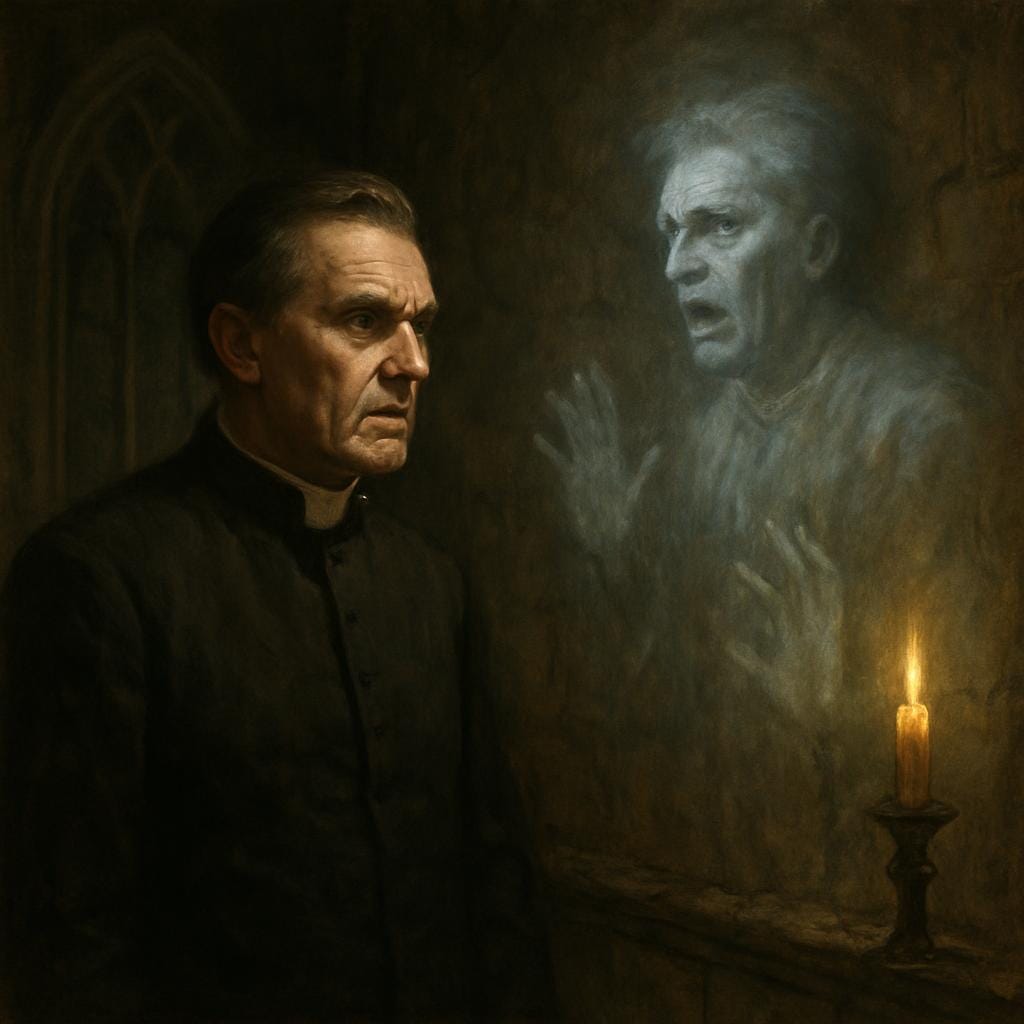
The temperature plummeted. And in the corner, he saw it: a shape, indistinct at first, then coalescing. The outline of a man, but wrong. Elongated, the proportions were subtly inhuman.
Every prayer he’d ever learned fled his mind. All that remained was terror.
“Fifty years,” the thing whispered, and Philip heard it not with his ears but inside his skull. “Fifty years I screamed while your Reverend Hawthorne prayed outside. While he convinced them I had the Devil in me. While he walled me up alive in this space to ‘cleanse’ my madness.”
Philip’s rationalist mind gibbered, still reaching for explanations. Shared delusion. Carbon monoxide poisoning. Some kind of mass…
But he could feel it. The same spiritual faculty that had always known God was real now screamed that this, too, was real.
“1891,” the voice continued. “I came to him, hearing voices. Seeing visions. What you’d call schizophrenia now. What he called demonic possession. He was so certain. So rational in his certainty. Just like you.”
Philip’s hands shook. “The rites... the church has rites...”
“Yes. The same rites Hawthorne used whilst I screamed. Prayers don’t mean much when you’re the one deciding who deserves saving and who deserves suffering.”
Mark stood frozen in the doorway. Sarah had collapsed, unconscious. And Philip, who had spent forty years in comfortable distinction between faith and superstition, could only stare at the horror his predecessors had created.
“Was I possessed?” the thing mused. “Or just ill? Hawthorne never asked. Never sought medical care. Never considered he might be wrong. He believed, you see. Believed so strongly in his own discernment that he couldn’t see he was torturing a sick man to death.”
It drifted closer, and Philip could see now what suffering had made of it: lips cracked from screaming, fingers worn to bone from scrabbling at brick, eyes that held an eternity of torment.
“And you,” it whispered. “You with your careful rationalism. Your refusal to believe in ghosts whilst believing in God. At least Hawthorne was consistent. But you… You hedge your bets. Pray when it’s comfortable. Dismiss when it’s not. Which makes you worse, I think. Because you know better, and still you turned them away.”
Philip felt tears streaming down his face. “I didn’t know. I couldn’t have known…”
“But you should have listened. Should have held the tension instead of collapsing into certainty. That’s the real sin, isn’t it? Not being wrong. Being too afraid of being wrong to take the risk of helping.”
The shape reached out one spectral hand, and Philip felt it pass through his chest, a violation so profound he gagged. Fifty years of darkness flooded into him. Fifty years of abandoned prayers. Fifty years of a sick man screaming for help whilst a priest blessed his torture.
Then it was gone.
Philip found himself on the floor, gasping. Mark was calling an ambulance, cradling Sarah. The wall looked ordinary again.
But Philip was not ordinary. He would never be ordinary again.
He had held the tension his whole life: between faith and reason, miracle and medicine, the transcendent and the empirical. But he’d held it dishonestly, always choosing comfort over risk, scepticism over vulnerability.
The Bennetts recovered. Sarah spent time in hospital. Yes, there was trauma, yes, there was mental strain. But there was also something else, something the psychiatrists couldn’t name. Philip visited regularly, and this time he didn’t explain away their experience. He sat with it. With them. Held their suffering without needing to categorise it.
He learned, slowly, to pray differently. Not for certainty, but for wisdom to discern. Not for neat answers, but for courage to stay present with mystery.
He still gives his sermons. Still counsels the troubled. But now he says, “I don’t know,” more often than “I can explain.” He’s learned that faith means trusting God enough to admit when you don’t have all the answers.
And sometimes, late at night, he feels that cold presence in the corner of his bedroom. Not quite hostile now. Perhaps just checking. Making sure he remembers.
He does remember. He will always remember.
Some suffering is supernatural. Some is natural. Some is both. And the real sin is being too afraid to stay present to the difference, to hold the tension without collapsing into comfortable certainty.
He sleeps poorly.
But he sleeps honestly.
And perhaps that’s a kind of grace.
Alan /|\