
The Vergers Hour
A tale from the Vellum Athenaeum
The Verger’s Hour
I
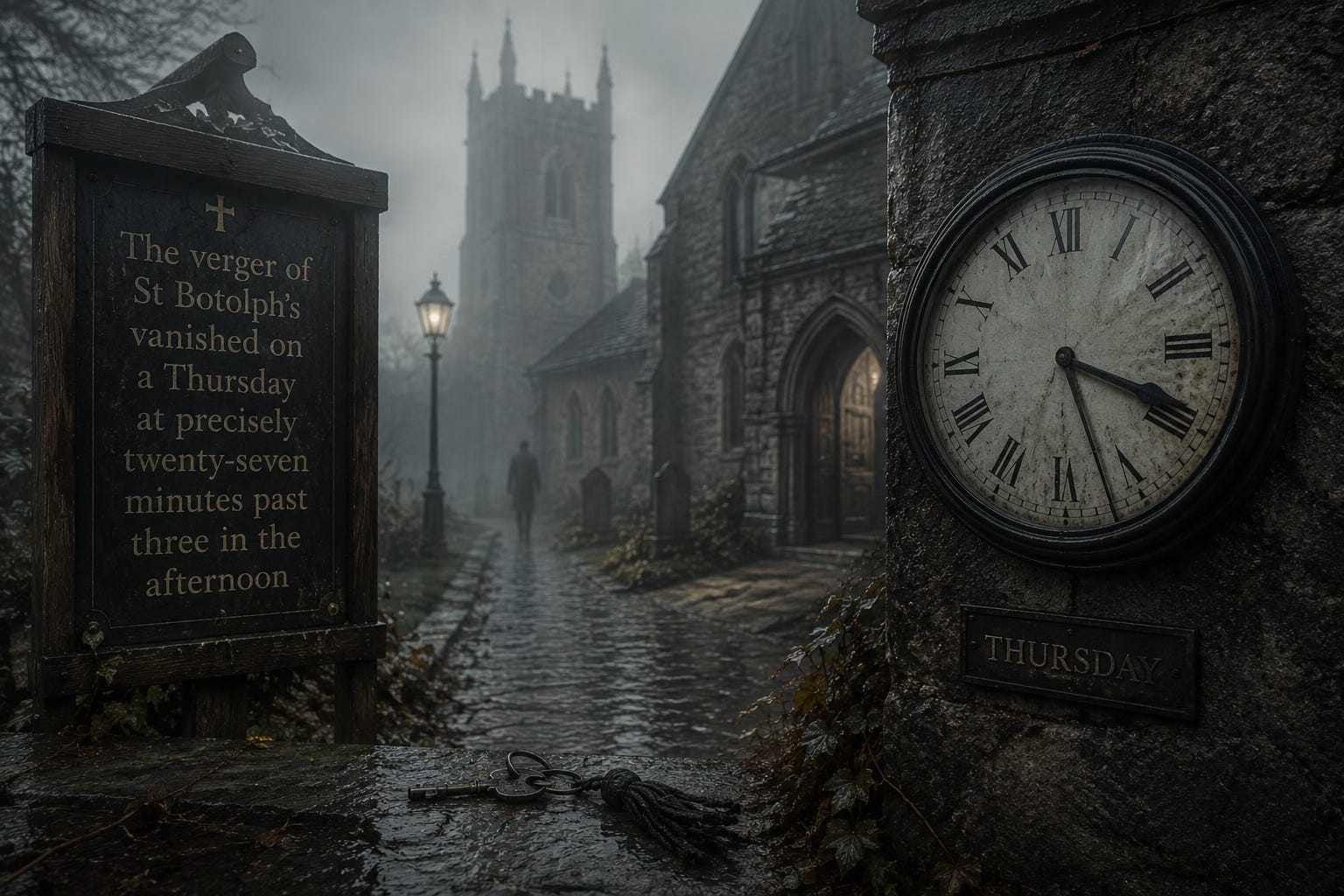
The verger of St Botolph’s vanished on a Thursday at precisely twenty-seven minutes past three in the afternoon.
This was known with unusual precision because the church clock had stopped at that exact moment, and had not started again, and the bell-ringer, a man called Pettifer who took his timekeeping personally, considered this a matter of greater outrage than the disappearance itself.
The verger’s name was Edmund Cooke. He was sixty-one years old. He had served St Botolph’s for twenty-nine years. He kept the brasses polished and the hymnals tidy. He had, in his small back office, a kettle and a tin of digestive biscuits and a framed photograph of a spaniel that had died in 2014.
He was last seen walking into the vestry with a duster. The vestry had one door. The vestry had no window large enough for a man of Edmund Cooke’s build to climb through. The vestry, when the curate opened it at four o’clock, contained the duster, neatly folded, and nothing else.
The duster was on the altar. Nobody had put it there.
II
Inspector Callum Brace was called on the Friday morning. He drove down the coast road with his notebook on the passenger seat and a flask of tea that was, for once, properly hot, because his wife had filled it. His wife had been kinder lately. He did not know why. He had a sense, a sense he could not place, that he had been quieter at home for some weeks, and that his quietness had made her tender.
He pulled into the lane beside St Botolph’s. The church was small and grey and squat, the way old Northumbrian churches are squat, as though they had been pressed down into the earth by centuries of weather. The graveyard ran down to a stone wall, and beyond the stone wall there was a field, and beyond the field there was the sea.
The curate met him at the lychgate. The curate was young and unhappy.
“Inspector.”
“Reverend.”
“It’s good of you to come.”
“It’s my job.”
“Yes,” said the curate. “But it’s good of you.”
Brace let that pass. He opened his notebook. He wrote St Botolph’s, Cooke, E. at the top of a clean page.
“Show me the vestry,” he said.
III
The vestry was small and smelled of beeswax and damp stone. There was a row of pegs for cassocks. There was a cupboard for the parish silver. There was a wooden chair with a thin cushion that had, over many years, taken the shape of a particular pair of buttocks, and Brace did not need to ask whose.
He stood in the centre of the room. He turned in a slow circle. He looked at the floor. The floor was flagstone, worn smooth, and in the centre of the room there was a slight depression, as though one stone sat lower than its neighbours.
He crouched. He pressed the stone. It did not move.
“Has this always been like this?” he asked.
“I don’t know,” said the curate. “I never noticed.”
“Get me Cooke’s diary, please. And his keys, if you have them. And anyone who saw him on Thursday.”
The curate went. Brace remained crouched. He took out his notebook. He wrote stone, sunken, central. He underlined it once. He did not underline it twice. Underlining twice was for things he was certain about, and at this stage he was certain about nothing, except that the air in the vestry was colder near the floor than near the ceiling, which is not how air ordinarily behaves.
He stood up. His knees complained. He ignored them.
He had a feeling, then, of a kind he had been having more often in recent months. It was the feeling that he had been here before. Not in this vestry. In a situation that resembled this one. A room with a wrongness in the floor. A missing man. Cold air rising the wrong way.
He took out the notebook. He flipped back through the pages. He had developed a habit of reading the older entries when these feelings came. They steadied him. They proved that things had happened.
He found the entry from October. Halloway, M. The Athenaeum. Vellum. He did not entirely remember the events the entry described. He remembered the shape of them, the way you remember a dream you woke from sweating. He remembered Iris Vane. He remembered a young man called Tomás. He remembered that something had been resolved.
He remembered also, with a chill, that the entry ended: If you have forgotten things, that is because you chose to. Do not undo it.
He stared at that for a long moment.
Then he closed the notebook. He left the vestry. He went to find a telephone.
IV
Dr Iris Vane answered on the fourth ring.
“Vane.”
“It’s Brace.”
“Callum. You sound tired.”
“I am tired. I have a verger who has walked into a vestry and not come out. The clock has stopped. There is a stone in the floor that sits lower than it ought. And I have a feeling.”
“What sort of feeling?”
“The sort I write down.”
There was a pause on the line. He could hear the distant sound of pages turning. Iris was rarely without pages.
“Where?” she said.
“St Botolph’s. South of Ravensgate. About four miles.”
“I know it. Mediaeval. Twelfth-century font. There is a crypt.”
“There is?”
“There was. It was bricked up in 1798. The reason given at the time was ‘damp’. The reason was not damp.”
“What was it?”
“I shall tell you when I arrive. Send Tomás the address. He is faster on the coast road than I am, and he needs the practice.”
She rang off. Brace stood for a moment with the receiver in his hand, and he thought, she did not ask me what was in the duster. That is because she already knows that the duster is not the point. And he thought, she also did not ask me how I am, which is because she knows I would not tell her.
He hung up the telephone. He went back to the vestry. He did not step on the stone.
V
Tomás Eberhardt arrived at half past eleven in a small green car that had belonged to his mother. He parked it badly, in the manner of those who learned to drive in cities, and he came up the path with his coat unbuttoned and his hair in his eyes.
He was twenty-three and a half. The half mattered to him. It mattered because in the six months since the affair of the book, he had not slept a full night, and the half-year felt to him like a far longer span of time than it had any right to be.
He was carrying a leather satchel. In the satchel was a notebook, a fountain pen, a small brass instrument that resembled a tuning fork, and a paper bag containing two cheese-and-pickle sandwiches that his landlady had made him because she said he was getting thin.
He was getting thin. He had not eaten the sandwiches she had made him on Wednesday either.
Brace met him at the lychgate.
“Lad.”
“Inspector.”
“You look terrible.”
“Thank you.”
“How’s the listening?”
Tomás’s mouth twitched. It was not quite a smile. It was the muscular acknowledgement that a smile was theoretically possible.
“Loud,” he said. “Lately. There’s been weather offshore.”
“Does weather offshore matter?”
“It does if you are carrying a memory of drowning, yes.”
Brace nodded. He did not entirely understand. He did not need to.
“Iris is coming.”
“Good.”
“There’s a vestry. There’s a stone.”
“Show me.”
VI
Tomás stood in the vestry for a long time without speaking. He turned his head very slowly, like a man listening for a faint instrument in a noisy room. After perhaps a minute, he took the small brass tuning fork from his satchel. He struck it against the edge of the wooden chair. He held it up.
The fork rang. The ring lasted longer than it should have. Then it began, very softly, to ring at a second pitch, a half-tone lower, which a tuning fork is not supposed to do.
Tomás watched it. His face did not change.
“There’s a hollow,” he said. “Under the stone.”
“The crypt.”
“Older than the crypt. Deeper.”
“Cooke?”
Tomás closed his eyes. He held the fork near the stone. He listened. He listened for so long that Brace began to feel uncomfortable, in the way one does when watching another person concentrate on something one cannot perceive.
At last Tomás opened his eyes.
“He’s down there,” he said. “He’s alive. He’s at a desk. He’s writing.”
“Writing what?”
“I can’t tell. I’m not a Reader. Iris will be able to tell.”
“Why is he down there?”
“Because he was offered a position, I think. And he accepted.”
Brace looked at the young man. He looked at the stone. He looked back at the young man.
“A position with whom?”
Tomás slipped the fork back into his satchel.
“With the firm,” he said. “It is generally called the firm. Iris will explain. I’d rather she did. She does it better than I do, and I have only the bare outline.”
VII
Iris Vane arrived at twelve forty-three in a taxi from the Athenaeum. She had her stick and her cardigan and a leather case which she set down on the wooden chair with the air of a barrister entering chambers. She nodded to Brace. She nodded to Tomás. She looked at the stone.
“Ah,” she said.
“Ah,” agreed Tomás.
“Right,” she said. “We have perhaps three hours. After that he will have signed.”
“Signed what?” said Brace.
Iris sat down on the edge of the chair. She rested her hands on her stick. She spoke as one delivering a lecture to two students who needed the lecture, and who had paid for it.
“There is, in the bureaucracy of the Auditors, a particular department called the Office of Quiet Accommodations. It is staffed by clerks. The clerks are recruited from among the living. The terms of recruitment are favourable, in their way. The recruit is offered work of profound importance. The recruit is offered the answer to one question that has troubled him all his life. The recruit is offered a desk, a lamp, and a kettle. In exchange, the recruit signs a contract of indenture. He becomes a clerk. He copies ledgers. He does this for what is, by his subjective experience, a very long time.”
“How long?” said Brace.
“He will perceive it as approximately four hundred years.”
Brace wrote 400 in the notebook. He stared at the figure. He did not underline it. There were no underlinings adequate to it.
“And in our time?”
“In our time, somewhere between an afternoon and a week. The Office is not synchronous with the surface.”
“And then?”
“And then he is returned. He is very old. He is, as a rule, no longer interested in the world. He is given a small pension and a cottage, and he spends his remaining months sitting by a window and not speaking. There are seven such cottages on the coast. The Athenaeum knows where they are. We send them tea at Christmas.”
“Christ,” said Brace.
“Indeed,” said Iris. “Though He is not, strictly speaking, in this jurisdiction.”
VIII
Tomás cleared his throat.
“The recruitment,” he said. “It only works if the recruit goes willingly.”
“Yes.”
“So we can’t just pull him out.”
“No. He has, in a sense, accepted an invitation. The invitation came with terms. If we extract him by force, we incur the penalty he would have paid for breach. And he will, regardless, have his memory of the invitation, and he will accept again, and again, until he is taken.”
“What was the question?” said Brace.
The two of them looked at him.
“You said the recruit is offered the answer to one question that has troubled him all his life. What was Cooke’s question?”
Iris’s eyes narrowed slightly. It was the expression she wore when a student had asked something she had not expected.
“That,” she said, “is the right question, Callum. That is the question that gets us in.”
IX
They went to find the curate. The curate was in the church hall, drinking instant coffee and looking at his hands.
“Reverend,” said Iris. “Did Edmund Cooke have a wife?”
“No. He was a widower. His wife died in 2009.”
“Children?”
“A son. The son lives in Carlisle. They are not close. They have not been close since the 1990s.”
“Why?”
The curate hesitated.
“I don’t know that it is my place to say.”
“It is now,” said Iris, gently. “Please.”
The curate looked at his coffee. He set it down.
“Edmund’s son was not Edmund’s biological son. Edmund discovered this in 1994. It was, as I understand it, the great wound of his life. His wife had died without ever being asked about it directly, and Edmund had loved her too much to ask while she lived. He never knew who the father was. He never knew whether his wife had loved the other man, or whether it had been a single mistake, or whether the boy had been conceived in some other circumstance entirely. He told me once, in confidence, that this not-knowing was the thing that kept him awake. He said it was the only thing he would ask God, if God could be asked.”
There was a silence in the church hall. Somewhere outside, a rook called.
“Thank you, Reverend,” said Iris.
She stood up. She walked back to the vestry. Brace and Tomás followed.
“That,” she said, when they were inside with the door closed, “is the question. The Office will have offered to tell him. And he will have accepted. Of course he will have accepted. Twenty-nine years of polishing brasses with that question in his chest. He would have signed in his own blood and counted it a bargain.”
“So what do we do?” said Brace.
“We answer the question first,” said Iris. “We answer it before he signs. Then the offer is void. There is nothing to exchange. The Office cannot purchase what he already owns.”
“And how do we answer it?”
Iris looked at her watch. She looked at Tomás. She looked at Brace.
“We go to Carlisle,” she said. “Or rather, one of us does.”
X
It was Brace who went, because Brace had the car and the warrant card and the kind of face that opens doors in unfamiliar towns.
He drove west across the Pennines in the early afternoon. The sky was the colour of old pewter. He drove fast. He thought, I am driving to ask a man whether he knows who his father was, on behalf of the father he believed was his, who is currently being offered eternity in a basement. He thought, six months ago this sentence would have been incomprehensible to me. And he thought, I am no longer the man who would have found it incomprehensible. I have become someone else. I am not entirely sure when this happened.
He found the house in a terrace on the edge of Carlisle. He knocked. A man answered. The man was perhaps forty, with grey at the temples and tired eyes and Edmund Cooke’s nose, although Brace did not yet know this, because he had not seen a photograph of Edmund Cooke.
“Mr Cooke?”
“Yes.”
“Inspector Callum Brace, Northumbria Police. May I come in? It concerns your father.”
The man’s face did something complicated.
“Which one?” he said.
XI
Inside, the kitchen was clean and small and smelled of toast. The younger Cooke, whose name was David, sat down opposite Brace at a Formica table. He folded his hands. He did not offer tea. Brace did not ask for it.
“Your father, Edmund, has gone missing.”
“I see.”
“He may be in danger.”
“I see.”
“I need to ask you something. It is going to seem an unusual question. I would not ask if it were not urgent.”
“Go on.”
Brace took a breath.
“Do you know who your biological father is?”
David Cooke sat very still. Then, slowly, he reached into his jacket pocket. He took out a wallet. He took from the wallet a photograph, soft at the edges, the colours faded. He pushed it across the table.
It was a photograph of a young man in army uniform. The young man was smiling. He had Edmund’s nose, although Brace still did not know this. He was perhaps twenty years old.
“My mother told me,” said David. “On her deathbed. In 2009. She told me his name. She told me where he was buried. He was killed at Suez. He never knew. She loved him. She loved him before she met Edmund. She loved him after she married Edmund. She loved Edmund too, but differently. She told me she had been a coward not to tell Edmund. She made me promise to tell him after she was gone.”
“And did you?”
David Cooke looked at his hands.
“No.”
“Why not?”
“Because I thought it would hurt him. Because I thought he would rather die not knowing than know. Because I am a coward too, I suppose. I have inherited it from her. It is the one thing of hers I am certain I have.”
Brace looked at the photograph. He looked at David Cooke. He looked at his watch. It was twenty past two. He had perhaps an hour.
“Mr Cooke,” he said. “I am going to ask you to do something difficult. I am going to ask you to come with me. To St Botolph’s. Now. There is a chance, a small chance, that we can find your father and you can tell him. I cannot explain the rest of it. I would not be believed if I did. But I am asking you to come, on the basis that I am a police officer and I am asking.”
David Cooke looked at him. He looked at the photograph. He looked at the clock above the cooker.
“I’ll get my coat,” he said.
XII
They drove east faster than Brace had ever driven on the Pennine road. The plastic dog on the dashboard nodded hysterically. David Cooke sat in the passenger seat with the photograph in his hand and did not speak.
They arrived at St Botolph’s at twenty-three minutes past three.
Iris and Tomás were in the vestry. Iris was kneeling on the flagstones, which must have hurt her terribly, and she was drawing something in chalk around the sunken stone. Tomás was holding his tuning fork against the stone and his face was white.
“He’s about to sign,” said Tomás.
“How long?” said Brace.
“Two minutes. Perhaps three.”
Iris stood up. She brushed chalk dust from her hands.
“Mr Cooke?” she said.
“Yes.”
“You understand none of this.”
“No.”
“Good. That will help. Kneel here, please. On the stone. Place your hand flat against it. Speak the answer to your father’s question. Speak it clearly. Speak it as though he were in the next room. He will hear you. The stone will carry it. Do not be afraid. Do not stop, no matter what you feel beneath your hand.”
David Cooke knelt. He placed his hand on the stone. He spoke.
He told his father the soldier’s name. He told his father where the soldier was buried. He told his father that his mother had loved the soldier, and had loved his father too, and that he, David, was the proof that two loves could exist in one woman, and that neither of them diminished the other. He told his father that he was sorry he had not told him sooner. He told his father that he loved him. He told his father, also, that the spaniel had been a good dog, and that he remembered her.
He spoke for perhaps ninety seconds. When he stopped, the stone beneath his hand was warm. He did not lift his hand. He waited.
There was a long silence in the vestry.
Then, very faintly, from beneath the stone, came a sound. It was the sound of a man weeping. It was the sound of a man weeping in a way one weeps when one is alone, and when one has waited thirty-one years to weep in that particular way, and the permission has at last arrived.
Iris closed her eyes. She let out a long, slow breath.
“It is done,” she said. “He has refused the contract. The pen is on the desk and he has set it down.”
XIII
The stone shifted. Not violently. It rose, an inch, perhaps two, as though something beneath had pressed it up from below. Tomás stepped forward and slid his fingers into the gap, and Brace knelt and helped, and between them they lifted the stone aside.
Beneath was a narrow stair. The stair went down further than the light from the vestry could follow.
Edmund Cooke came up the stair. He was sixty-one years old. He looked, as he climbed, like a man who has been holding his breath for a very long time, and who has at last remembered how to breathe.
When he saw David, he stopped. He stood on the second-to-last step. He looked at his son. His son looked at him. Neither of them spoke. After a moment, Edmund Cooke held out his hand. David Cooke took it. Edmund Cooke stepped up out of the stair, and onto the flagstones of the vestry, and into the ordinary afternoon light.
He looked around. He looked at Iris. He looked at Tomás. He looked at Brace.
“I left the duster on the altar,” he said. “I am sorry. I should not have done that.”
“It is forgiven,” said Iris.
“Thank you,” said Edmund Cooke.
He walked out of the vestry, holding his son’s hand, and they went together down the aisle of the church and out through the south door and into the graveyard, and they sat on a bench by the wall, and they talked. They talked for a long time. They were still talking when the light failed.
XIV
In the vestry, Iris sat down on the wooden chair. Her knees were trembling. She did not show it. She allowed herself, in the privacy of her own mind, to be a woman who was tired.
Tomás slid the stone back into place. He did it carefully. He left no gap.
Brace stood by the door. He had taken out his notebook. He had not yet written anything.
“Iris,” he said.
“Yes.”
“The clock. Outside. Will it start again?”
“It has already started. Listen.”
He listened. Somewhere above them, in the tower, the church clock was ticking. He had not noticed when it had begun.
“Iris,” he said again.
“Yes.”
“How many people accept the Office’s offer?”
She looked at him. She looked at him for a long time. There was something in her look that was not pity, exactly, but was related to pity by marriage.
“More than you would think, Callum. Almost everyone has a question. The Office knows them all. It is very patient.”
Brace nodded. He wrote in his notebook. He wrote: Cooke, E. Returned. The Office offers answers. Beware of being offered an answer to a question that has hurt you for a long time.
He underlined it twice.
He thought, then, of a notebook entry from the autumn, in his own handwriting, that began I had a brother. He had read it many times. He had read it that morning, in fact. He read it most mornings. He did not know what the brother had looked like, or what his voice had been, or whether they had played together as boys. He knew only what he had written.
He thought, if the Office offered me the answer to where my brother went, I would sign. I would sign in this notebook. I would sign now.
He closed the notebook. He put it in his coat pocket. He buttoned the coat.
“Cup of tea?” said Iris.
“Yes,” said Brace. “Please.”
XV
They walked together up the lane to the small tea-room above the post office. Tomás carried Iris’s leather case for her, because her knees were bad now, and she would not say so but he knew. The light over the sea was the colour of weak whisky, going to ash.
In the tea-room they sat at a table by the window. They ordered three teas and a plate of shortbread. The woman behind the counter knew Iris by name. She knew Tomás by his grandmother. She did not know Brace, but she nodded to him with the careful neutrality of small towns that have learned not to ask questions of men with notebooks.
They drank their tea. They did not say much. There was not much to say that was not better left in the vestry, in the stone, beneath the flagstones.
After a while, Tomás said, very quietly, “There were others down there.”
Iris looked up.
“Yes?”
“At the desks. I saw them. Through the fork. I didn’t tell you because I didn’t want to slow us down. There were rows and rows of them. Cooke was at the end of one row. There was a woman two desks across from him. She had a green coat hanging over the back of her chair.”
Iris set down her teacup. She set it down very carefully. The cup did not rattle on the saucer, because Iris was a woman who could be tired and frightened at the same time and still set down a cup without rattling.
“Halloway,” she said.
“I think so. I couldn’t see her face.”
“She returned the book. She apologised. She should be free.”
“She wasn’t. She was writing.”
Iris was quiet for a long moment. She looked out of the window. The sea, in the distance, was very dark.
“Then we have not finished,” she said. “We have not finished with the Halloway business. The book came back, but the borrower did not.”
“What do we do?” said Tomás.
“Not tonight,” said Iris. “Tonight we drink our tea. Tomorrow we begin again.”
Brace looked at the two of them. He had been listening. He had not understood all of it. He had understood enough.
He took out the notebook. He turned to a fresh page. At the top, he wrote: Halloway, M. Not finished. Green coat in the Office. To be investigated.
He underlined it once. He paused. He underlined it again.
Outside, the church clock at St Botolph’s, four miles away, struck the hour. The sound came faintly across the fields and through the glass of the tea-room window. Three of them heard it. None of them remarked upon it. They sat together and they drank their tea, and the dark came in over the sea, and somewhere, in a room without windows, a woman in a green coat was still writing, and her pen did not stop, and her pen did not stop, and her pen did not stop.
The third case will require a journey. Not down, this time. Across. The coast has cottages on it, and one of them has a light in the window that should not be lit, because the man who lit it last has been dead since 1981. But that is for another evening, and another tide.
Alan /|\