
The Reconciliation
A cautionary tale

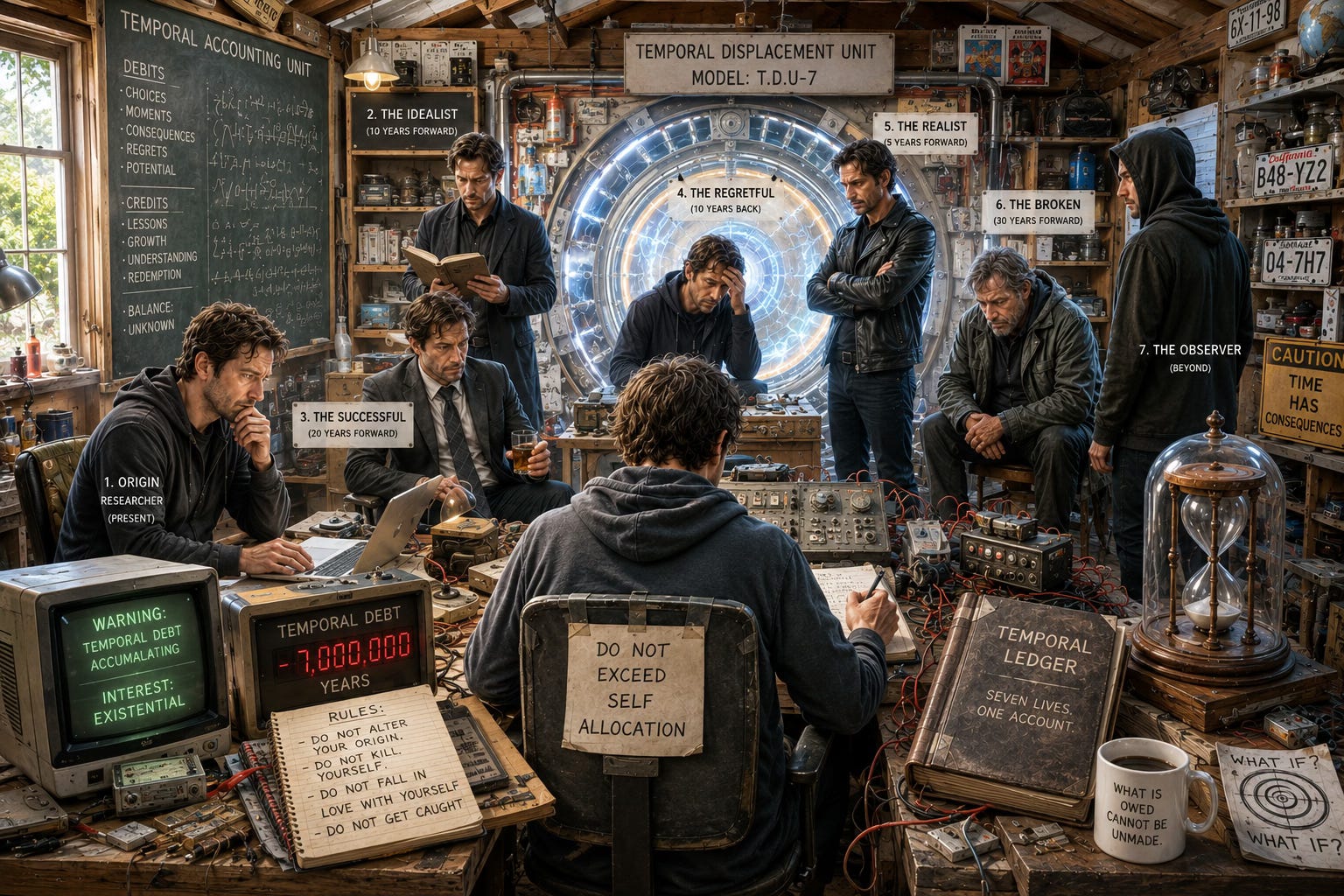
THE RECONCILIATION
A cautionary tale of temporal accounting
The machine worked on the first attempt. That was the first sign that something was wrong.
Dr Elias Merton had budgeted for failure. Failure was the family trade. His father had failed at farming. His grandfather had failed at the ministry. Merton himself had failed, quietly and with tenure, at theoretical physics for twenty years. He was comfortable with failure. He kept it like a dog.
The plans had arrived in March. A brown envelope. No stamp. No sender. Forty pages of circuit diagrams in his own handwriting. He knew his own handwriting. He had spent a lifetime apologising for it. He checked the envelope for a note. There was no note. There was only a compliments slip, blank except for one line.
You will want to keep receipts.
He built the machine in the garage because the garage had a lock. His wife had left in the autumn so,there was no one to ask about the humming. It took him eleven weeks. He followed his own instructions without understanding most of them, which was, he reflected, the story of his entire adult life.
* * *
The first test was a coffee mug. He set the dial for a gap of five minutes and pressed the switch. The mug went away without fuss. Merton stood in the quiet garage and waited to feel something. Then he remembered. The mug had already arrived. It had arrived that morning, five minutes before he thought of the test, sitting on the bench where no mug had been.
He had washed it and used it for his tea. He had drunk his tea from a paradox and noticed nothing except that it needed sugar.
There were now two mugs.
He could not bring himself to destroy either one.
This would prove to be the pattern.
For a while, the loops closed neatly. He would go back, watch himself from behind the boiler, and wait. At the appointed hour, the earlier Merton would step into the machine and depart. The ledger of the world balanced.
One Merton in, one Merton out. It was tidy. It was almost dull.
Then, on a Thursday in July, the Merton who arrived declined to leave.
He remembered standing behind the boiler, he said, watching himself refuse to get into the machine. So he refused. You cannot argue with the record.
That is not how it works, Merton said.
Evidently it is, said Merton.
There were now two of them. By October, there were seven.
* * *
They organised. Merton was, in all his editions, an organiser. They drew up a rota for the washing up and a schedule for the one bed. They kept minutes because seven identical men in one house would otherwise argue over what was agreed. Each of them privately believed himself to be the original. The minutes recorded this belief as unanimous.
Merton Four kept a spreadsheet. Merton Two did the accounts. Merton Six developed opinions about the garden that none of the others recognised as his own. This frightened them more than the physics did. Nobody minuted it.
The first letter came in November. Brown envelope. No stamp. The heading read Office of Temporal Reconciliation, and beneath it, in smaller type, the year of establishment had been left blank. The letter was in his handwriting. All seven of them confirmed it independently. Which is to say the same man confirmed it seven times.
Which is to say nothing.
That was the general direction of things by then.
The letter said the account was overdrawn. Mass and history had been borrowed against the timeline, and the timeline, like any lender, charged interest.
Seven Mertons existed, whereas the books showed only one.
The surplus would need to be reconciled. A schedule was enclosed. It proposed one reconciliation per month, method at their discretion, and it closed with a sentence he recognised as his own, because he had used it in every grant application of his career. We trust this arrangement will prove satisfactory to all parties.
They held a meeting.
The minutes run to nine pages.
They record, among other resolutions, that the letter was probably a hoax, that it was certainly a hoax, that, nevertheless, a subcommittee would be formed, and that the biscuits were nearly out.
* * *
The machine had a setting they had not used. The dial could be set to a destination. It could also be set to none. Merton One tested it with the second mug. The mug did not go anywhere. It simply stopped being included. No flash. No sound. Where the mug had sat, there was only the bench, and the bench had the look of a bench on which no mug had ever sat. All seven of them found they remembered only one mug, though the minutes said two. After some discussion, they agreed to trust the minutes.
They drew lots in December. Merton Five drew the short straw and took it well, which was worse than if he had wept. He spent his last week finishing the guttering, because he did not like to leave a job half done. On the final evening, he shook six identical hands, stepped into the machine, and set the dial to none. Then there were six of them, and none could quite remember what the seventh had been called. The minutes say only this. Reconciliation effected. Guttering complete.
In February, Merton Three proposed going back to March of the previous year and intercepting the envelope. No plans, no machine. No machine, no surplus. It was, he argued, the only moral exit.
The motion was debated for three hours. Merton Two pointed out that if the machine were never built, none of them would exist to prevent it, and the prevention would therefore not occur, and the machine would therefore be built, and here they all were. Merton Three replied that this was exactly the kind of thinking that had got them into this. The motion was defeated, four votes to one, with one abstention. Merton Three was selected at the next drawing of lots. The minutes note the coincidence and offer no comment. Minutes never do.
* * *
The lots continued. The house grew quieter. The washing-up rota simplified itself month by month, which was the only mercy anyone could point to.
By September, there was one Merton left, and he no longer troubled himself about whether he was the original. He had watched that question decided six times by a bag of straws and had learned what the question was worth. He kept the minutes up to date, because someone should. He did the guttering. He drank his tea from the mug and did not think about the mug.
The last letter came in October. It thanked him for his cooperation. The account, it said, was nearly balanced. One entry remained outstanding, and it was not the one he assumed. Enclosed was a second envelope, brown, without a stamp or an address, and a compliments slip on which he was invited to write one line. Beneath the invitation, in his own hand, was a suggested form of words about receipts.
He sat in the garage for a long time with the forty pages of plans on his knee. He did not remember drawing them. He had never remembered drawing them. He copied them out fresh, because the letter asked, and because his hand seemed to know the diagrams better than his mind did. When he finished, the copy and the original were identical in every particular. He could no longer tell which he had made and which had made him.
He sealed the envelope. He set the dial for March.
There was one thing the letters had never told him, and the minutes could not. Whether he was the first Merton or only the most recent. Whether the loop had a beginning or merely a balance. Whether a man who posts his own fate to himself is its author or its addressee.
He pressed the switch. The account is presumably settled. But no ledger on earth records who opened it.
Ledgers never do.
Alan /|\
This was wonderfully unsettling. The bureaucratic treatment of time travel, paired with the dry humor and the recurring meeting minutes, made the paradoxes feel both absurd and deeply human. The ending lingers long after the last line. Do you see this as a closed loop, or is there still a way for Merton to break the cycle?