
The Favour Returned
A tale from the Vellum Athenaeum
The Favour Returned
I
The black car came up the harbour road at twenty minutes past ten on a Wednesday morning in late June.
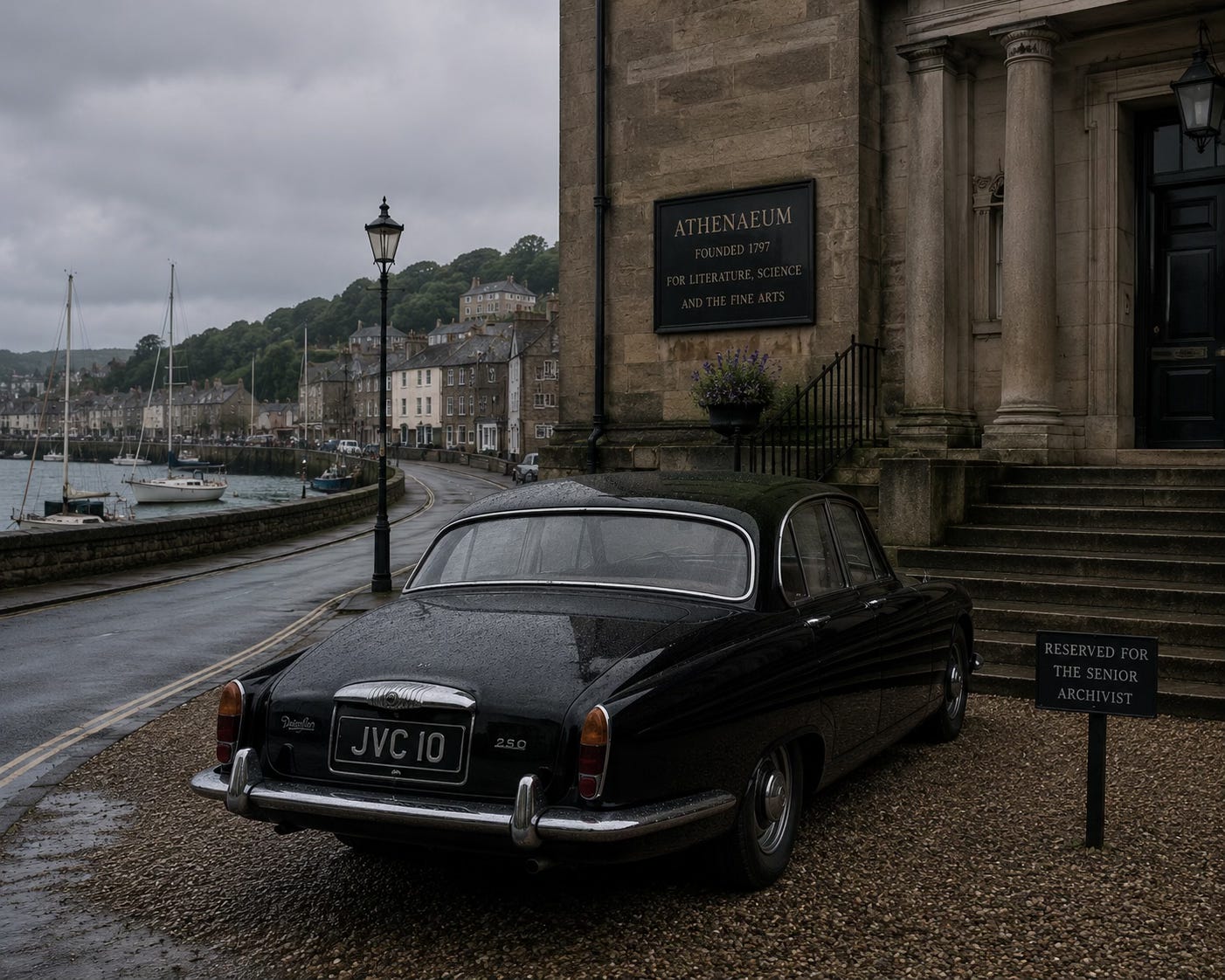
It was a Daimler, perhaps twenty years old, kept in the condition of cars that are not driven often but are driven by people for whom appearance is a matter of arithmetic. The chrome was clean. The black was the black of a window at midnight in a house with no light. It came up the harbour road slowly. It did not park in the visitors’ bay. It parked, instead, on the gravel at the foot of the Athenaeum’s steps, in the spot reserved for the Senior Archivist, who was, as ever, abroad.
Tomás Eberhardt was at the upper window of the south reading room when he saw it. He had been re-shelving a small run of seventeenth-century devotional pamphlets, and he had paused, as he often did when re-shelving, to look out at the harbour, which was, that morning, the colour of weak tea. He saw the car. He saw the driver get out. The driver was a small man in a dark suit who walked round the bonnet and opened the rear passenger door with the precise economy of someone who has done it ten thousand times.
A man got out of the back of the car. The man was perhaps seventy. He wore a charcoal overcoat over a charcoal suit. He carried no case. He walked up the steps of the Athenaeum without looking up at the building, which was, in Tomás’s limited experience, a thing that no visitor had ever done.
Tomás watched him disappear under the porch. Then he set down the pamphlet he was holding, which was a 1683 sermon on the matter of restitution, and he went down the back stair to find Iris.
II
Iris was in her office. She was at her desk. There was a teacup in front of her. The teacup was empty. The kettle, on the small electric ring by the window, was off. Iris was not reading anything. She was sitting with her hands folded on the desk, and she was looking at the door.
Tomás came in. He did not knock. He had stopped knocking some weeks before, on her instruction, on the grounds that the time taken to knock was time that could be spent on more urgent matters. He came in.
“There’s a man,” he said.
“Yes.”
“He came in a Daimler. He’s downstairs.”
“Yes.”
“You know who he is.”
“I know who he is.”
Tomás looked at her. She had, in the eleven and a half months he had known her, three faces. The first was the working face, which was attentive and slightly amused. The second was the tired face, which she put on when alone and which he was permitted, by degrees, to see. The third was a face she had shown him only once, when Mr Wren of the Department of Late Submissions had sat in her office in April, and she had concealed it almost at once, before Tomás could be certain of what he had seen. That face was on now. She was not, this time, concealing it.
“Iris.”
“Sit down, Tomás.”
He sat. He sat in the three-legged chair, which had, by mutual unspoken agreement, become his chair, and which tilted, as it always did, in a manner that was companionable rather than dangerous.
“Twenty-three years ago,” said Iris, “in 2003, I was twenty-nine. I had been Reader of Marginalia for two years. I had taken the post on the death of my predecessor, who was Dr Halliwell, whom you have heard me mention in the matter of Eli Marsh. Halliwell died suddenly in October 2001, and I was promoted from Junior Reader to Reader at an age that the Trustees considered indecent and which they nevertheless ratified, on the grounds that there was no one else qualified, and that the building had, on the night of Halliwell’s death, made certain rearrangements in the lower stacks which the Trustees interpreted as a vote of confidence.”
“All right.”
“In 2003 I was working on a matter that I will not describe in detail. The matter concerned a young woman in the parish who had inherited, through an obscure chain of bequests, a small object that should not have been in private hands. The object was, by the standards of the Athenaeum, dangerous. The young woman did not know what it was. She kept it on her mantelpiece. It had been on her mother’s mantelpiece. It had been on her grandmother’s mantelpiece. It was, the family believed, a piece of decorative pottery from the Crimea.”
“It was not.”
“It was not. I attempted to recover it by ordinary means. I went to the young woman. I explained, in such terms as I could, that the object was Athenaeum property and had been mistakenly deaccessioned in the 1840s, and that I should like to repurchase it. She refused. The object had a sentimental value. She would not part with it. I made a larger offer. She refused. I made the largest offer the Athenaeum could justify. She refused. She was not, by then, refusing for sentimental reasons. She was refusing because the object had begun, by that point, to make refusals on her behalf.”
“It had her.”
“It had her. Not severely. Not yet. But enough that ordinary persuasion would not work. And the object’s degree of having her was, week by week, increasing. By my estimate, she had perhaps six months before the object would be in a position to use her seriously.”
“What did you do?”
“I went outside the Athenaeum for help.”
Iris paused. She looked at the empty teacup. She did not, Tomás noticed, reach for the kettle, although it would, in her ordinary practice, have been the moment for tea.
“I went to a man called Edmund Gault. Mr Gault was, at that time, a senior figure in a quiet organisation based in the south. The organisation has no public name. It has, internally, several. It is not part of the Athenaeum. It is not part of the offices of the Auditors. It is not part of any government. It is, in its own description, a body of useful gentlemen. It has been a body of useful gentlemen since approximately the reign of George the Third. It does work that the Athenaeum cannot do, because the Athenaeum is, by its charter, restricted to the holding and study of materials. It cannot, by its charter, send men to people’s houses to remove things by force, even where force is, on balance, kinder than the alternative.”
“And Gault can.”
“Mr Gault could and did. I asked him, in 2003, to remove the object from the young woman’s house. He agreed. He did so, on a Friday in May, with great efficiency and minimal distress. The object was placed, the following Monday, in my hands at the Athenaeum, where it now resides in the lower stacks under the catalogue number 1847-K-9, on a shelf I do not visit, in a casket I do not open, with a small printed card in front of it that reads no enquiries to be entertained.”
“And the young woman?”
“The young woman recovered, slowly. She moved away from the parish. She lives, now, in Carlisle. She is a married woman of fifty-one with two grown children and a job in local government. She does not remember the matter at all, by my arrangement, and she is well.”
“All right.”
“In exchange for Mr Gault’s services, I accepted a favour. The favour was open. Mr Gault did not specify, at the time, what it would consist of. He said only that one day, perhaps in his lifetime and perhaps not, he would request a favour in return, and that the favour would be of equivalent weight to the service rendered. I agreed. I shook his hand. The agreement was witnessed by his deputy and by Mr Croft, who had come down with me as Mr Croft, in those days, did when I went outside the Athenaeum for business of a delicate nature.”
“And now Mr Gault is downstairs.”
“Mr Gault is downstairs. And the favour is, I think, about to be requested.”
She looked at the door.
“I do not know what the favour will be, Tomás. I want to be clear about that. I have not been told in advance. The agreement of 2003 was, very deliberately, left open. I have spent twenty-three years not thinking about it, in the way that one does not think about a loan one cannot repay. I am about to find out what I owe.”
III
There was a soft knock at the door. Mr Croft put his head in.
“Dr Vane. Mr Gault.”
“Show him up, please, Mr Croft.”
“Yes, Dr Vane.”
Mr Croft withdrew. Iris looked at Tomás.
“You will stay. I want a witness. Brace is not in the building today, and we do not have time to fetch him. You are, by now, a competent witness. Sit where you are. Take out your notebook. Write down what is said. Do not speak unless I direct a question to you. If at any point Mr Gault addresses you directly, answer briefly and return the conversation to me.”
“Yes.”
“And Tomás.”
“Yes.”
“Mr Gault is not, in the sense we have been using the word in recent months, a danger. He is not from any office. He is not from any department. He is, in the ordinary sense, a man. He is, however, a man who has spent fifty years doing very particular work, and his presence in a room has a quality. Do not be unsettled by the quality. It is, in part, deliberate.”
“All right.”
Mr Croft brought Mr Gault up. Mr Gault came in. He stood for a moment in the doorway.
He was tall, but not very tall. He was thin, but not very thin. His face was, on first glance, an ordinary face. On second glance, it was not. The eyes were grey, and they were the grey of a stone that has been in a riverbed for a long time, and they did not move very much. The mouth was small and neat. The hair was white and short. He was, Tomás would later think, the only man he had ever seen who looked exactly his age, in the sense that one could read his age from his face with the precision of reading a clock, and one would not be wrong by a year.
“Iris.”
“Edmund.”
“Thank you for receiving me.”
“I have not, yet, received you. I have permitted you to be in the room. The receiving will come, or not, depending on the request.”
“Fair.”
He came in. He sat in the chair opposite her, which had not previously been her visitors’ chair, and which Mr Croft must, Tomás realised, have brought up the stairs that morning before opening. The three-legged chair, the visitors’ chair, had been promoted out of use for the day. Mr Croft thought of these things. He always had.
Mr Gault did not look at Tomás. He did not, in fact, appear to register that there was a third person in the room. This was, Tomás understood, also deliberate. He took out his notebook. He opened it on his knee. He uncapped his pen.
“Edmund,” said Iris. “Before you ask, I will say this. The favour of 2003 stands. I have not, in twenty-three years, attempted to evade it, nor disputed its existence, nor reduced its weight. It is open. I have considered it open since the day I shook your hand. I am prepared, in principle, to honour it. The question of whether I will honour it in fact will depend on what you ask.”
“Of course.”
“What do you ask?”
Mr Gault did not answer at once. He looked at her hands, which were folded on the desk in front of her. He looked at the empty teacup. He looked, briefly, at the small electric kettle on the windowsill, which was unplugged.
“May I have tea, Iris?”
“You may.”
She did not get up. She did not, by any movement, indicate that she would make it. She sat with her hands folded. After a moment Mr Croft, who had not, Tomás realised, left the room, but had withdrawn to stand by the door, came forward and went to the kettle and made the tea himself. He made it in the small brown pot. He poured it into two cups. He set one in front of Iris, and one in front of Mr Gault, and then he withdrew to the door again.
Iris did not drink.
Mr Gault took a small sip. He set the cup down.
“I am dying, Iris.”
She did not move.
“I have, my physician tells me, somewhere between three and seven months. I have made my arrangements. The arrangements are, in the ordinary sense, complete. My affairs are in order. My deputy is competent. My organisation will continue. I am not here on any matter of business. I am here on a matter that is, in the strictest sense, private.”
“Go on.”
“In 1971 I married a woman called Caroline Allerby. We were married for thirty-one years. She died in 2002, in the November, a year before you and I had our conversation about the object on the mantelpiece. She died of a stroke. She was fifty-eight. Her death was sudden and complete, in the sense that she did not regain consciousness from the moment of the stroke to the moment of the death, which were six hours apart. I was with her for the last four. She did not, in those four hours, speak.”
He paused.
“I am, Iris, an unusual man in my own life. I have done unusual work for many decades. I have, in the course of that work, learned a great deal about what is and is not possible in the matter of the dead. I have, in particular, learned what is not possible. I know more about what is not possible than almost any living person. I know, for example, that one cannot speak with one’s dead wife. I know that the offices that purport to allow such things are, almost without exception, frauds, and that the small number that are not frauds are very much worse than frauds. I know that the dead do not, in any sustained way, wish to be spoken with, and that the apparent desire of the dead to communicate is, in nearly all cases, the desire of something else wearing the dead person’s name.”
“Yes.”
“I know all of this. I have lived by knowing it. I have not, in twenty-three years and seven months, attempted to speak with Caroline. I have not gone to mediums. I have not gone to séances. I have not consulted any of the organisations that operate in the spaces I am familiar with. I have, in the matter of my wife, conducted myself with the discipline of my profession.”
“Yes.”
“I am, however, going to die. In some months. And before I die I should like, once, to ask her a question. One question. The question is not, in itself, important. The question is whether she heard me, in the last four hours of her life, when I spoke to her. I spoke to her for four hours, Iris. I told her, in those four hours, every thing I had not told her in the thirty-one years. I do not know whether she heard. I would like to know whether she heard. I would like, very much, to know whether she heard.”
He stopped. He did not look up. He looked at his hands on the table.
“I am asking, Iris, for the Athenaeum’s help in this matter. I am asking because I do not trust any other body to do it without taking from me, in payment, more than I can afford. The Athenaeum, I believe, can do it. I believe that you, in particular, can do it. I am asking because I am, for the first time in my life, in a position in which the rules I have lived by do not, any longer, entirely apply. I am dying. I have, in some sense, already crossed a threshold. The asking is, itself, a small failure of discipline. I am asking anyway.”
He looked up. His grey stone eyes were, for the first time, fully visible to Tomás.
“This is the favour, Iris. This is what I am calling in. One conversation with my wife. One question. One answer. By means I trust, which means by you. I will pay any cost the Athenaeum requires, in addition to the favour, that is not the cost the offices would impose. I have means. I will write you a cheque this morning, if you wish, for any sum. The favour itself, the twenty-three years of it, I offer in full. That is the asking.”
IV
Iris was silent for a long time.
She did not look at Tomás. She did not look at Mr Croft. She looked at the cup of tea in front of her. She had not, still, drunk from it.
She said, at last, “Edmund. I want to make sure I understand what you are asking. You are asking me to arrange a single contact between yourself and the consciousness, or what remains of the consciousness, of your wife, Caroline Allerby Gault, who died in 2002. You wish to ask her one question. The question is whether she heard you in the last four hours of her life. You wish me to do this by means that do not involve any of the offices.”
“Yes.”
“You understand that the Athenaeum does not, ordinarily, perform such services. That we hold materials. That we read margins. That we are a library.”
“I understand. I also understand that the Athenaeum has, in its lower stacks, certain materials that could be used to facilitate what I am asking. I know this because Halliwell told me, in a moment of confidence in 1989, what some of those materials are. He told me one of them in particular, by name. I have not, in thirty-seven years, repeated the name to any living person. I will not repeat it now. I will say only that I know it exists, that I know you will know what I mean when I refer to the third Pell-receiver, and that I know it could, in your hands, be used for this purpose.”
Iris closed her eyes.
She closed them for perhaps five seconds. When she opened them, her face had changed by a small but visible degree.
“Halliwell told you about the Pell-receivers.”
“In 1989. In confidence.”
“Halliwell was indiscreet.”
“Halliwell was dying. He had three weeks. He told me certain things in the spirit in which a dying man tells his successor’s colleague certain things, which is to say in the hope that they will be useful and not in the certainty that they will be wisely used.”
“And you have kept the knowledge for thirty-seven years and have used it now.”
“I have.”
Iris was quiet again.
Then she said, “Tomás. Please go and fetch Brace. He is at home today. Telephone him. Tell him I require him at the Athenaeum within the hour. Tell him I am, in this matter, asking him to set aside any plans he has made for the morning. He will come. Wait by the south door for him and bring him directly up. Do not say to him what the matter is. I will tell him myself.”
“Yes.”
Tomás stood. He looked, briefly, at Mr Gault. Mr Gault was, again, not looking at him. Tomás left the room. He closed the door behind him. He went to the porter’s lodge to telephone.
He did not, as he walked, know what to think. He had been told a great deal, very quickly, by people who were not in the habit of telling. He had heard, in a single sentence, the phrase the third Pell-receiver, which had passed through him in the way certain phrases do, leaving a small mark that he could not at once identify. The Pells. Henry Pell, the wireless operator who had drowned in 1943, whose remnant Iris kept in a small room in the lower stacks where she read to him from Conrad on Sunday evenings. There were, evidently, receivers. There were, evidently, three of them. There was, evidently, a third.
He did not, just then, want to think about what the third Pell-receiver might be.
V
Brace arrived at twenty past eleven. He had driven faster than was legal. He was unshaven. He had been, when Tomás had telephoned, in the middle of installing a new tap in the kitchen sink, his wife having declared the previous one a disgrace, and he had not, in his haste, removed the small streak of plumber’s putty from the side of his nose. Tomás did not mention the putty. He led Brace up the back stair.
In Iris’s office, the three of them sat. Mr Gault had moved to the window. He stood with his back to the room. He had not, Tomás noticed, drunk further from his tea. Mr Croft was still by the door.
Iris explained the matter to Brace in seven sentences. She did this with the economy of a barrister giving instructions to junior counsel. Brace listened without writing. When she had finished, he sat for a long moment.
Then he said, “Iris. Can it be done?”
“Yes.”
“Should it be done?”
She did not answer at once. She looked at Mr Gault’s back at the window.
“Edmund. Would you step outside for ten minutes, please? Mr Croft will sit with you in the small reading room. There is more tea there, and there are biscuits, which Mrs Dunbar made this morning. I should like to confer with my colleagues.”
“Of course.”
Mr Gault turned from the window. He inclined his head, very slightly, in the manner of his generation. He followed Mr Croft out. The door closed.
VI
“Can it be done,” said Brace.
“Yes. The third Pell-receiver is in the lower stacks. Its existence is known to perhaps four living people, of whom I am one and Edmund, apparently, is another. It is an instrument that was built in 1944 by a man named Aldous Pell, who was Henry Pell’s brother, and who became, after Henry’s death, one of the Athenaeum’s quiet contributors. Aldous Pell built three receivers. The first was destroyed in 1958. The second is held by a private collector in Edinburgh and does not function. The third is ours. It can, in skilled hands, permit one short and shallow conversation with a particular kind of consciousness that has not, yet, been fully claimed by the offices. The conversation is limited. It is, in essence, a question and an answer.”
“Caroline Allerby qualifies?”
“Caroline Allerby, by my preliminary assessment, qualifies. She died suddenly. She did not, in her last hours, make any of the standard arrangements that would have placed her under the jurisdiction of the offices. She was a Church of England woman, of moderate observance, who had not, in her life, drawn the attention of anything we would recognise. Her death was, in the technical sense, unclaimed. The offices do not, ordinarily, claim such deaths. They simply pass. Caroline Allerby passed. She is not, by my expectation, in any office. She is, by my expectation, simply absent. Which is, from the receiver’s point of view, the easiest condition to query.”
“And what is the cost?”
“The cost,” said Iris, “is the difficult question.”
She turned to Tomás.
“Tomás. The cost is what we are conferring about. Listen carefully. The Pell-receiver does not draw cost from the questioner. The questioner pays only attention. The cost is paid by the operator of the receiver. The operator, in this case, would be me. The cost is calibrated to the distance the receiver must reach and to the firmness of the answer required. For a conversation of the kind Edmund is requesting, the cost would be, in my estimate, approximately eleven years.”
“Eleven years,” said Brace.
“Of my remaining time.”
“Iris.”
“It is what the receiver requires. I have studied it. The figure is approximate. It could be ten. It could be twelve. It will not, I think, be less than nine, and it will not be more than thirteen.”
“You would die in your sixties,” said Brace.
“I would die in my sixties. Yes.”
Tomás found that he could not, for a moment, speak. He found that his hand was holding his pen too tightly, and that the pen was pressing into his palm in a way that was painful, and that he did not want to relax his grip on the pen, because relaxing his grip on the pen would mean that he had accepted, even in a small way, the fact of what had just been said.
“Iris,” he said.
“Yes.”
“There must be a way to redistribute. To pay it differently.”
“There is no way to redistribute. The receiver does not accept distributed payment. It requires a single operator who pays in full. That is part of how it works. The narrowness of the channel depends on the singleness of the payment.”
“Then we say no.”
She looked at him.
“We can say no. That is what I am conferring about.”
She turned to Brace.
“Callum. You have known me for one year. You have known Edmund for none. You have, however, learned, in the last year, a great deal about how the work of the Athenaeum sits against the work of the offices, and how it sits against the work of other bodies. I want your view. Should I honour the favour of 2003?”
Brace was quiet for a long moment. He looked at his hands. There was, still, the streak of plumber’s putty on his nose. He did not, just then, remember it.
“Iris. I am going to ask you a question first. In 2003. When you accepted the favour. Did you know it could be this?”
“I knew it could be anything.”
“Did you know it could be this.”
“I knew it could be a payment of years. Yes. I considered, at the time, that the worst conceivable request would be of that order. I accepted on the understanding that I might, one day, be required to pay in time.”
“And you accepted anyway.”
“I had a young woman with an object on her mantelpiece. The object would have killed her by Christmas. I had no other way to remove it. Yes. I accepted.”
Brace nodded.
“Then I think, Iris, that the answer is yes. You honour it. You honour it because you knew what you were signing, and because Mr Gault has, by his account, kept his side of it without ever invoking it for trivial purpose, and because he is asking now for a thing that is, on its face, a private kindness, and because the woman he is asking about did not, by your reading, opt into anything that would prevent us. You honour it. You honour it knowing the cost. You honour it because not honouring it is, in this profession, the worse of the two paths.”
He paused.
“But Iris.”
“Yes.”
“I want to say one further thing. I want to say it because I am the policeman in this room, and because the policeman is sometimes useful for noticing the obvious.”
“Go on.”
“There is the favour. There is the cost. These are settled. But there is also the question. The question Edmund wishes to ask. He wants to know whether she heard him. Iris. Has it occurred to you that the answer, in itself, may not, perhaps, be a kindness? He has not heard from her for twenty-three years. He has, in his head, presumably, a version of her hearing him. He has lived with that version. The version may, in his interior life, have settled into a kind of comfort. If the answer is no, she did not hear, you will have spent eleven years to remove the comfort he has built. If the answer is yes, she heard, you will have spent eleven years to confirm something he already, by his actions, lives as if he believes. The transaction, in either direction, is not obviously a benefit to him. The transaction is, perhaps, the act of a dying man who is no longer reasoning as he used to.”
Iris was quiet for a moment.
“That is true,” she said. “Yes. That is true.”
“So I would say this,” said Brace. “Honour the favour. But do not honour it by giving him what he asked for. Honour it by giving him what he needs. Find out what he needs. It may not be the conversation. It may be the offer of the conversation, in itself. It may be the having-asked. It may be the being-permitted-to-ask. Some men, when permitted to ask a thing, find that the asking was enough. I do not say Edmund is that man. I say only that we should find out, before you sit down at the receiver.”
Iris looked at Brace for a long moment. Her face did something that Tomás could not, at first, read. Then he saw that she was smiling, slightly, in the way one smiles at a friend who has, unexpectedly, said the right thing.
“Callum. You are, sometimes, very good at this.”
“I am occasionally lucky.”
“Bring him back in.”
VII
Mr Croft brought Mr Gault back. Mr Gault sat down again opposite Iris. He did not, this time, go to the window. He sat. He folded his hands. He waited.
“Edmund,” said Iris.
“Yes.”
“I am going to honour the favour. I want you to hear that first, before anything else. I am going to honour it. It will be honoured.”
“Thank you.”
“I am not, however, going to honour it in the form you have requested. I am going to honour it in a different form. I am going to honour it in the form that is, I think, the form you actually need, which is not, I think, the form you have requested. I want to explain. Listen, please, before you respond.”
“Go on.”
“You have asked for a single conversation with Caroline. One question. The question is whether she heard you in the last four hours of her life. I will, before this morning is finished, sit at the Pell-receiver and ask that question on your behalf, if at the end of our conversation you still wish me to. I will tell you, before I sit down, what the cost to me will be. I will not lie about it. I will not minimise it. You may, at that point, instruct me to proceed, or to stand down. The choice will be yours. But before you choose, I want to ask you a question of my own. And I want you to answer it honestly. Will you?”
“I will.”
“Edmund. In the twenty-three years since Caroline died, you have lived as if she heard you. You have lived as if those four hours mattered. You have, by your own account, conducted yourself with discipline. You have not gone to mediums. You have not sought, through any back channel, the answer you are now asking me for. Why not?”
He looked at her. The grey stone eyes did not move.
“Because I knew the answer would be unreliable from any other source.”
“That is part of it. That is, perhaps, the surface of it. What is underneath?”
He did not answer at once.
“I do not know,” he said, at last.
“I think you do. I think you have, in twenty-three years, considered the question many times. I think you have not asked, even of yourself, the underneath of the question. I am asking you now. Why have you waited until you were dying?”
He was silent for a long moment.
“Because,” he said, “if the answer is no, I do not want to live with it. I would prefer to die with it. I would prefer, if she did not hear, to know it only briefly. To know it for a month, or three months, or seven months. Not to know it for twenty-three years.”
“Yes.”
“And if the answer is yes, I would like to know, before I go, that the four hours were what I believed them to be. I would like to carry that, into whatever comes next, as certainty rather than as hope.”
“Yes.”
“Those are the reasons. They are not noble. They are, I am afraid, the reasons.”
“They are entirely human reasons, Edmund. There is nothing in them that is not honourable. I want to be clear about that. You have not, in asking, done anything that any reasonable man in your position would not have done. The favour is, in itself, a reasonable favour. I will honour it. But I want to ask you one more thing.”
“Go on.”
“Suppose I told you that I knew. Suppose I told you that I, Iris Vane, by means that do not involve the Pell-receiver, by means that involve only my having read, over the years, certain margins, and having spoken, over the years, with certain colleagues, and having developed, over the years, a certain professional judgement of what is and is not likely. Suppose I told you that, in my judgement, she heard you. Suppose I told you that I believed it. Suppose I told you that I would say so to you, here, in this office, with Mr Croft and Inspector Brace and Mr Eberhardt as witnesses, and that I would say it on my professional reputation, and that I would not, in saying it, be deploying the Pell-receiver, and would not be paying eleven years. Would that be enough?”
She looked at him.
“I am not, Edmund, asking you to accept my judgement as a substitute for hers. I am asking you whether, given the alternative, you would accept my judgement as a working basis on which to live the remaining months. If the answer is no, we sit at the receiver this afternoon. If the answer is yes, we do not.”
Mr Gault was silent. He was silent for a very long time. The clock in the entrance hall, two floors below, struck twelve. The chimes came up faintly through the stone.
“Iris,” he said. “Do you, in your professional judgement, believe she heard me?”
“Edmund. I do. I will tell you why. The dying, in the last hours, in conditions of the kind you describe, almost always hear. The exterior signs of unconsciousness are not, in the offices’ understanding, an accurate map of the interior. The body shuts. The hearing does not. The hearing is, in fact, often the last of the senses to be lost, and in cases of sudden cerebrovascular event the auditory cortex frequently remains active for many hours after consciousness, in the layman’s sense, has departed. The dying hear. They hear, often, with a clarity they did not have in health. They hear, often, as one hears in a quiet room at the end of a long day. They cannot respond. They hear. This is not a comforting belief I have constructed. It is the consistent finding of two centuries of margins, in the records of this Athenaeum, kept by readers who have, in their own family deaths, tested the matter against the receivers and other instruments. The dying hear. Caroline heard you. I would say so under oath. I would say so in writing. I will, if you wish, write it for you now, and sign it, and Mr Croft will witness it, and you will have it on paper, with the seal of the Athenaeum, before you leave this building.”
Mr Gault did not move.
“You would do that.”
“I would do it.”
“And it would not cost you eleven years.”
“It would cost me nothing. It is what I believe. It is what I would say to any colleague who asked. I am offering to say it to you, formally, on paper, because I think it is, in fact, what you came here for, although you did not, perhaps, know it when you came.”
He looked down at the desk. He looked at his hands. He looked at the cup of tea that he had not, in the long minutes since, drunk from.
“Iris.”
“Yes.”
“I think you are right.”
“Yes.”
“I think I came here for permission to believe what I have, in fact, believed for twenty-three years. I think I have wanted, all along, not the answer but the warrant. I think the favour, when I offered it, was a kind of price I expected to have to pay, in order to be allowed to keep what I already had. And I think you have just, very kindly, told me that I do not need to pay it.”
“I do not need you to pay it, Edmund. I do not want you to pay it. I do not want to pay it. I will pay it, if you ask me to. But I will be grateful, very grateful, if you do not.”
He looked up.
He was, Tomás saw, beginning to weep. He was weeping in the manner of men of his generation, which is to say without sound, with the tears moving down his face and his face not otherwise changing. He did not lift his hands to his face. He let the tears run.
“Then I do not ask you to. I withdraw the request in its original form. I accept your offer in the substituted form. I should be very grateful, Iris, for the document on paper, with the seal. I will keep it on my desk. I will look at it, occasionally, in the months that remain. It will be a kindness.”
“It will be done by the end of the morning, Edmund.”
“Thank you.”
“And Edmund.”
“Yes.”
“The favour remains discharged. We are even. The twenty-three years are settled. You owe nothing further. I owe nothing further. We may, in our remaining time, speak as friends, without anything between us.”
“Thank you, Iris.”
“You are welcome.”
VIII
Iris wrote the document in the next half-hour. She wrote it in her own hand, on a sheet of the Athenaeum’s heavy cream paper, with the seal pressed in red wax at the foot. She wrote it in two paragraphs of careful prose. She did not, in the writing, lie, and she did not exaggerate. She wrote what she had said, which was that in her professional judgement, formed by twenty-five years of reading and informed by the Athenaeum’s records, the dying hear, and Caroline Allerby Gault, in the last four hours of her life, would, in her professional judgement, have heard her husband. She signed it. Mr Croft witnessed it. Brace witnessed it. Tomás witnessed it. The witnessing required no fewer than four signatures, by an Athenaeum convention dating to 1789, and Tomás’s was the fourth.
She folded the document in three. She placed it in a stiff envelope. She handed the envelope across the desk to Mr Gault.
Mr Gault took it. He held it in both hands for a moment. Then he put it inside his coat, in an interior pocket, against his chest.
He stood.
“Iris.”
“Edmund.”
“I will not, I think, return to the Athenaeum. There will not, in the months that remain, be a further occasion.”
“No. I do not think there will.”
“Then I will say goodbye, here, and we will not pretend that there is more business between us.”
“Goodbye, Edmund.”
“Goodbye, Iris.”
He inclined his head, in the manner of his generation, very slightly. He turned. He walked to the door. Mr Croft opened it for him. He went out. They heard his steps on the stair. They heard, after a long minute, the closing of the front door. They heard, after another minute, the engine of the Daimler.
The car moved away down the harbour road. None of them, in the office, went to the window to watch it go.
IX
Iris sat down. She had been standing. She had not, before that moment, allowed herself to sit. She sat. She took the cup of tea, which had gone cold, and she drank it in two swallows. She set the cup down.
“Mr Croft.”
“Dr Vane.”
“Thank you. You may go down.”
“Yes, Dr Vane.”
He went. He closed the door behind him.
Brace and Tomás remained. Iris looked at them. She looked at them for a long moment without speaking.
Then she said, “Callum. Thank you. You were right, in there. I would have sat at the receiver. I would have paid. I had, in the half-hour before you came, accepted that I would. You gave me a way that I had not, alone, been able to find. You gave him a way also. Thank you.”
“I was lucky.”
“You were not lucky. You were, in the moment, useful. There is a difference. Lucky is what one says to deflect being seen. You were useful. Accept it.”
“All right.”
She turned to Tomás.
“Tomás. You have been very quiet.”
“Yes.”
“You have something to say.”
“Yes.”
“Say it.”
He looked at his notebook. He had, he saw, not written anything in it. He had not, in the entire conversation, made a single note. He looked up.
“Iris. The receiver. The third Pell-receiver. It is in the lower stacks.”
“Yes.”
“And it could be operated. It could be used. By you. To pay eleven years for a single short conversation.”
“Yes.”
“There are, I assume, other things in the lower stacks. Other instruments. Other items that have, like the Pell-receiver, costs that are paid by the operator.”
“Yes.”
“How many.”
She was quiet for a moment.
“Approximately forty-seven.”
“Forty-seven.”
“Yes.”
“And the operator, in each case, would be you.”
“Or, in time, Tomás, you. Or, after us, whoever follows. The lower stacks do not, in general, accept volunteers from outside the Athenaeum. The instruments are, in their way, particular about who operates them. They prefer Readers of Marginalia. They prefer, by long custom, the post and not the person. I happen to currently occupy the post.”
“And you would, if asked by anyone with the standing to ask, pay.”
“I would consider each request on its merits. I would not, in general, refuse outright. I would weigh. I would negotiate. I would, where possible, find a substituted form, as I did today.”
“And where not possible.”
“Where not possible, I would pay.”
“How much, in total, have you paid?”
She did not answer at once.
“Tomás.”
“How much, Iris.”
She looked at him. She looked at him for a long moment. Brace, beside him, did not move.
“Eight years,” she said. “Across three operations. None of them today. Two in the 1990s, when I was Junior Reader, on instruction from Halliwell. One in 2011, on my own initiative, in a matter I will not describe. Eight years.”
“You are sixty-four.”
“My body is sixty-four. My account is, in the Athenaeum’s reckoning, seventy-two. The two figures do not, in ordinary observation, diverge in any obvious way. The instruments take, when they take, in a manner that does not produce visible aging. They take from the duration, not from the appearance. I will, by my reasonable expectation, die at the age my account has reached, which is to say at approximately the age of eighty-four less eight, which is to say seventy-six. I had, in 2003, an expected lifespan of approximately ninety. I now have an expected lifespan of approximately seventy-six. I have, you may calculate, fourteen years left, if I take nothing further. If I had paid the eleven today, I would have had three.”
Tomás found that his eyes were wet.
“Iris.”
“Yes, Tomás.”
“I did not know. None of that. I did not know any of it.”
“No.”
“You did not, in any of the cases this year, mention it. In the Halloway case. In the verger. In Sleeking. In the letter from Lillian. In the child with the figure. You did not say.”
“No. There would have been no purpose. The instruments were not the right tools for those cases. The costs we paid in those cases were paid by others, or were paid in kinds that the instruments do not deal in. The instruments are for a particular class of problem. They are for the problems that cannot be solved any other way. I do not, in general, reach for them. I reach for them when I must. I have, today, very nearly reached for them. Brace stopped my hand. I am grateful.”
“How many years do I have to give. To the instruments. If I become Reader of Marginalia.”
She looked at him.
“That, Tomás, is a question that you do not have to answer today. It is a question you will, in time, answer for yourself, in each case as it arises. The Reader of Marginalia is not required, by any charter, to operate the instruments. The Reader is required only to consider, in good faith, each request that comes in. The Reader may refuse. The Reader has, in the past, refused. Halliwell refused twice. I have refused four times. Each refusal was, in itself, a decision that the Reader had to live with. Refusal is not, in itself, a failure of the post. It is part of the post. You will, if you take the post, refuse some and accept others. The arithmetic is yours.”
“How will I know.”
“You will know. You will know by the same means you have learned, in the past year, to know other things. You will know by sitting with the question, and reading the margins, and asking yourself what you can live with. You will, in most cases, find that the answer is clearer than you expect. In a small number of cases, it will not be. In those, you will, I hope, have colleagues to confer with. As I, today, did.”
She looked at Brace.
“Thank you, Callum.”
“Iris.”
“Yes.”
“I am going to go home now. I am going to finish installing the tap. My wife will want her sink back. I will, on the way, drive slowly. I will, perhaps, stop at the harbour and look at the sea for a few minutes. I think I will need to.”
“Of course.”
“I will be at home tonight. If you need me, please ring.”
“I will not need you tonight, Callum. I will need you next week. There are matters to discuss. There will, I think, be more visitors of one kind or another, in the coming months. We have, this year, become a place that people remember. The remembering will increase.”
“Yes.”
He stood. He picked up his coat. He paused at the door. He looked at Iris. He looked at her for a moment longer than was, strictly, necessary.
“Iris.”
“Yes.”
“Eight years. Yes.”
“Yes.”
“Do not. Where possible. Pay more.”
“I will do my best, Callum.”
“Yes.”
He went. The door closed behind him.
X
Tomás and Iris sat together in the office. They sat for a long time without speaking.
The clock in the entrance hall struck the half-hour, and then the hour. The light from the window moved across the desk and onto the floor and onto the spines of the books on the lower shelves of the bookcase opposite. The kettle was off. The teacups were empty. Mr Croft, somewhere below, was, presumably, attending to whatever Mr Croft attended to in the hour after lunch.
Iris broke the silence, eventually.
“Tomás.”
“Yes.”
“There is a thing I want to say to you. I want to say it now, while we are here, because I do not know when, in the next year, there will be another quiet half-hour, and I would prefer to say it in a quiet half-hour than in a moment of business.”
“All right.”
“I am sixty-four. I have, by the arithmetic I just performed, fourteen years left. I may, in those fourteen years, choose to spend more at the instruments. I may not. I will, in either case, not be Reader of Marginalia for very much longer than ten or twelve years more. I will then be too old. The work requires, in its later stages, a certain bodily resilience that I will not, by then, have. I will retire, if the building permits, to a room on the upper floor. I will, in retirement, advise. I will not, in retirement, sit at instruments.”
“Yes.”
“You are twenty-four next month.”
“Yes.”
“You have not been told, in any explicit terms, that I am training you for the post. The Trustees have not, in any explicit document, named you the heir apparent. The building, however, has been, for some months, signalling. The building is, in my professional judgement, satisfied with you. The building is, in fact, pleased. The building does not, in my experience of forty-one years, become pleased lightly.”
“All right.”
“I am telling you this not because I wish you to feel a weight. I am telling you this because I think you should know, before you go any further into the year ahead of us, what is, in the building’s quiet way, being decided. You will be the next Reader of Marginalia. Not in three years. Not in five. But in ten, perhaps, or twelve. You will be the man who is asked, by the next Edmund Gault, whether he may have one conversation. You will be the man who calculates the years. You will be the man who, in the small office, with the kettle and the cardigan and the limp that I do not yet have but will, by then, in your case, develop in some form of your own, considers whether to pay or to find a substituted form.”
“Yes.”
“I am telling you this so that you can, in the time you have, prepare. I am telling you so that you do not, when the time comes, feel that you were taken by surprise. I am telling you so that, in the next ten years, you can, where possible, learn from me what is and is not worth the years. I do not, by saying this, ask you to commit. You may refuse the post, when offered. You may leave the Athenaeum. You may pursue any of a number of other professions. The building will be sorry, if you do, but the building will not, in any sense, hold you. You are not bound. You are, however, prepared. And I want you to know, now, that you are prepared.”
He did not, for a moment, speak.
“Iris.”
“Yes.”
“I will not refuse.”
“You may yet refuse. Twenty-four is young. You may, in three years, fall in love with someone in Manchester. You may, in five years, decide that the work is unbearable. You may, in seven, become, in some way, ill. Do not, now, promise.”
“I will not refuse, Iris. I am telling you. I am telling you in this office, on this afternoon, with the building listening. I will not refuse. I will, in time, take the post. I will, in time, operate the instruments. I will pay what I am required to pay. I am telling you this now, because if I am to be the next Reader of Marginalia, I would like the building to know that it is not, in the matter, being asked. It is being told. By me.”
She looked at him for a long moment.
Then she smiled. It was a small smile. It was the smile of a woman who had not, in many years, heard exactly that sentence, and who had, perhaps, wondered whether she would.
“Very well, Tomás.”
“Very well.”
“In that case. We have a great deal of work to do. Starting tomorrow.”
“Starting tomorrow.”
“Tonight, we rest. Edmund is gone. The Pell-receiver remains in its casket. The eleven years are not paid. The building is, I think, content. Mr Croft is, I think, also content. Mrs Dunbar is, I think, making something for supper. The day, on balance, has gone better than I had feared at half past ten.”
“Yes.”
“Go home, Tomás. Eat. Sleep. Tomorrow, come up early, and we shall begin the next thing.”
He stood. He picked up his notebook, which still had no notes in it for that morning, and which he would, that evening, fill from memory in his small flat above the chandler’s, in long careful sentences, because he had begun, in the last weeks, to understand that the future of the Athenaeum’s records would, in time, depend on the accuracy of his memory and on the discipline of his pen.
He went to the door. He paused.
“Iris.”
“Yes.”
“The forty-seven.”
“Yes.”
“You will, before you retire, show me each of them.”
“Each of them. Yes.”
“And tell me what they cost.”
“And tell you what they cost. Yes.”
“And tell me which ones you have used.”
“And which I have refused. Yes. All of it.”
“All right.”
He went. He closed the door behind him.
XI
In the office, Iris sat for a further hour. She did not, in that hour, work. She did not read. She sat at her desk with her hands folded, and she looked at the window, and she thought about a young woman in 2003 with an object on her mantelpiece, and about a man with grey stone eyes who had driven all the way from the south to ask for a conversation with his dead wife and had, in the end, accepted instead a sheet of paper, and about the eleven years she had not paid, and which would, in some account she could not see, be transferred from the debit column to the credit column, and would, in the slow arithmetic of the offices, count somewhere.
She thought, I have fourteen years. I had three this morning. I have fourteen now.
She thought, I would have paid. I am glad I did not have to.
She thought, Tomás will be a good Reader. He has the temperament. He has the patience. He has the eye for the margin. He will, in time, be better than I am. He will, in time, refuse more than I refuse, and pay less than I have paid, because he will have learned, from me, that paying is not the only available answer. I have, in him, an heir. I have, today, in admitting the heir to himself, made the building’s quiet decision an explicit one. The building is, I think, glad. The shelves in the upper Reading Room have, in the past hour, shifted by a small fraction. I felt it. The catalogue, tonight, will rewrite itself by a quarter of a page. We are, in this small way, continuous. The Athenaeum continues. The work continues. The work is not, today, my private burden. It is, today, a shared burden. It will be, in ten years, his.
She stood. Slowly. Her knees were, as they always were now, bad. She went to the kettle. She put it on. She made a fresh pot of tea. She drank it standing at the window, looking out at the harbour, where the small boats were coming in on the afternoon tide.
In the distance, at the far end of the harbour road, she could see, very faintly, the place where the black Daimler had been, and where it no longer was. She could see, beyond that, the road that ran south out of Ravensgate, the road that Mr Gault was now travelling on, with a sheet of paper in his interior pocket against his chest, a sheet of paper bearing her seal and her signature and the sentence the dying hear. She thought of him driving south. She thought of him driving towards his death, which would come in some months, in the ordinary way, with a sheet of paper to keep him company.
She thought, goodbye, Edmund. I am glad we did not have to do the other thing. I am glad we settled it with words on paper. I think, in our long lives, we have been instructed by certain bodies in the use of force, and have done much by force, and have come, by sixty-four and seventy, to prefer the settlement of business by words on paper, where it can be done. I am glad it could be done.
The kettle hissed faintly on the windowsill. The tea was, by now, drawn. She poured a second cup. She drank it slowly.
The light moved across the desk, and onto the floor, and onto the shelves opposite, and the afternoon went on without her, and the Athenaeum, in its slow and patient way, kept its books.
Unitil Next Time…
Alan /|\