
The Difference Between Animals
A probematic phobia for a Vampire.
I thought it was worthwhile to step away from the Vellum Athenaeum for a while and return to something else. We will, of course, visit there in the not-too-distant future.
Now, may I present to you….
The Difference Between Animals
I have been alive for six hundred years. Alive is the wrong word. Nobody has invented the right one.
I look twenty-five. Strangers tell me so in bars. They say it like a gift. They lean in and tell me I have lovely skin and I want to weep, because I have had this skin since the Medici were a going concern and it has never once tanned, scarred, or learned anything.
I am beautiful. This is not vanity. It is a complaint. Beauty was useful once, when one needed to be invited indoors. Now it only means that the thing I must do each month is done to someone who wanted to go home with me. I find this obscene. Nobody else seems to.
Here is the joke. Here is the part where God, if He is paying attention, laughs.
I cannot stand the sight of blood.
I faint. A vampire who faints. I have gone down at the first dark bead like a Victorian aunt at the mention of ankles. I have woken in ditches with my mouth open and the night half gone. The first hundred years were a humiliation I will not describe.
So I feed with my eyes shut. I have got rather good at it. You learn the geography of a throat by touch, the way a blind man learns a face. I do not look. I never look. If I look, I am no use to anyone, least of all the person I am killing, who deserves at minimum my full attention.
I have had good company through all this. The dead keep better hours than the living, and the clever ones kept worse, so we met in the small spaces of the night.
I knew Montaigne. Lovely man. Sad eyes. He told me that man is the only creature who kills for pleasure and calls it virtue, and I did not have the heart to tell him what I was, so I agreed and bought the wine.
I argued with Lucretius about death. He had the old Epicurean line off by heart. Where death is, you are not. Where you are, death is not. So death is nothing to you, and only a fool fears nothing at all. It is a beautiful medicine. I have never once been able to take it. The single cure on the shelf, and the label reads: not for him.
I drank with Hume in Edinburgh. Claret, not the other. He was fat and kind and frightened of nothing, which I found unbearable. I asked him whether the self carried on. He said he had looked very hard for his self and found only a bundle of sensations passing through. No thread. No little man at the centre holding the reins. I said I had looked for six hundred years and found the same, and he assumed I was joking, and I let him.
A monk told me much the same in a colder country. No self, he said. Only weather. Everything flows, nothing stays, hold on to nothing and you are free. He said it gently, the way you tell a child a thing it cannot yet use. I wanted to explain that I was the one knot the river would not carry off. That everything flows except me. The stone in the stream is not free. The stone is only lonely, and over the years it gets very smooth.
Schopenhauer told me that life was a pendulum between pain and boredom. He said it as though it were news. I had known it for four centuries. I nodded along like a man hearing the weather.
I came close to stopping, around then. Then I met Spinoza in a rented room, grinding lenses with the glass dust already in his lungs. A quiet man, the exact size of his enemies’ fear of him. He told me to look at things under the aspect of eternity. To see each thing not as a moment running past but as part of one whole, necessary and entire.
I told him I had eternity. I was made of the stuff. He said duration was not the same as vision. That a man might live one afternoon and see further than I had in six centuries. That I had been handed the longest view on earth and had spent it watching the clock.
This was not comfort. It was worse. It was a bill.
Kierkegaard, later, in a city of churches, named the rest of it. He had written a whole book about a sickness he called the despair of being unable to die. I read it like a man reading his own notes at the foot of the bed. To want the door and find it bricked. To be a self that cannot stop being a self. He had no cure either. But there is a strange relief in a good diagnosis, even when the prognosis is forever.
So they did help. Not in the way I wanted. None of them could stop the hunger. What they did, between them, was teach me where to point my eyes while it ran. For a while I thought that might be enough.
It was not. The body keeps its own counsel, and the body wanted feeding.
· · ·
So. The arithmetic.
I have to kill to carry on. I do not especially want to carry on. I do not, particularly, want to stop either, which is the trap, and the trap is the whole of it. I am too squeamish to live and too frightened to die.
For a long time I tried not to feed. I would last weeks. Then months. I shrivelled. I went grey and thin and began speaking to the furniture. Hunger does not kill us. It only makes us worse company. So I came crawling back to the throat every time, and hated myself, and the hatred was at least a hobby.
Then a butcher solved the other half of me. He did not mean to.
He was a big man in Smithfield with an apron like a battlefield. I had stopped, the way you stop at a thing you cannot bear to look at, and he caught my face and laughed.
He had a trick he did every day. He said folk would weep over a lamb and swallow a pig without a thought, and the pig was the cleverer animal by miles. He said we keep dogs on the sofa and pigs on the plate and nobody can tell you why. Only that one is family and one is dinner. The line between them, he said, is drawn in nothing but habit.
I went home and could not sleep, which is saying something, as I sleep through most of the day.
Because he was right. The line is arbitrary. We do not eat the stupid animals, or the cruel ones, or the ones that suffer least. We eat the ones we have decided not to call family. That is the entire moral architecture of the butcher’s window. Habit, dressed up as law.
And if the line is arbitrary, I thought, then I have only moved it. One animal further along. The same arbitrary nonsense everybody performs at supper, except I do not pretend it is anything else.
It worked. God help me, it worked. I sleep now. The argument is sound and I despise it.
I despise it because it is the worst kind of true. It does not make me good. It makes everyone else slightly worse, and invites me to stand among them. It is the philosophy of the lowest common denominator, and the lowest common denominator is where I now make my bed.
So I have my two arguments. One for the body, from a butcher. One for the eye, from a dead Dutchman with glass in his lungs. I would have liked them the other way round. I would have liked the deep thing to come from the deep men and the meat to stay meat. Instead the butcher fixed my conscience, and the philosophers only taught me how to look at what I had done.
· · ·
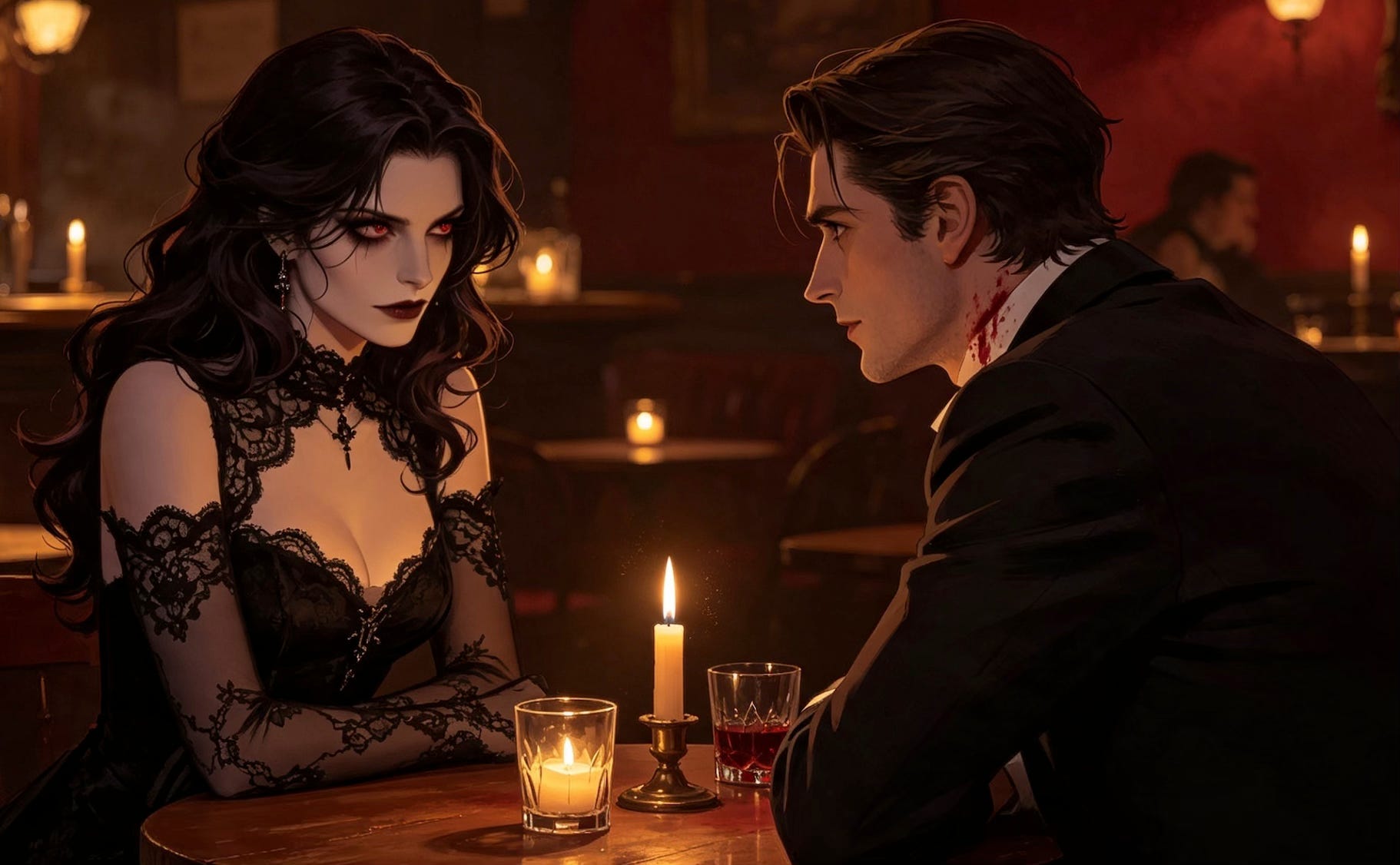
There is a man across the bar. He thinks I am twenty-five. He thinks tonight is the start of something. He is right, though not in the way he hopes.
I will shut my eyes, as I always do. I am still squeamish. Spinoza told me to see the whole of it, under the aspect of eternity, all at once and entire. With my eyes shut it is easier to pretend that I do.
You eat the animal you have decided not to love. I have simply decided about one more of them than you have.
Tell me where the line goes. Tell me exactly, and show your working.
I will wait. I have time. It is the one thing I was never short of, and the one thing nobody could teach me how to spend.
❧